

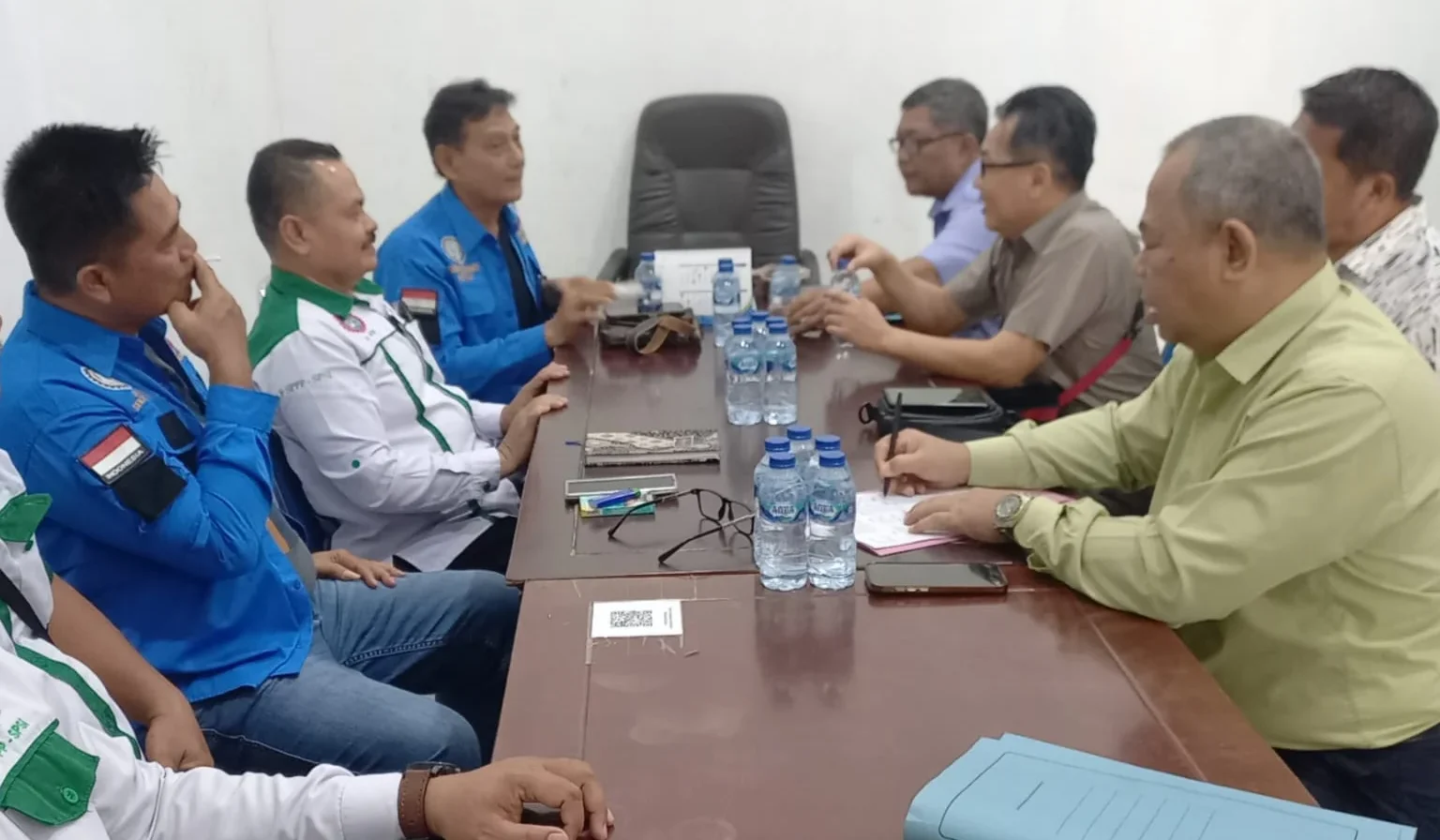
LANGKAT, HALOSUMUT.COM – The industrial climate in Langkat Regency has grown intensely volatile following announcements from a powerful coalition of labor unions and civil organizations.
The All-Indonesia Workers Union (SPSI) alongside the Pemuda Pancasila (PP) district chapter have officially declared their readiness to mobilize thousands of members to surround and stage a massive protest at the corporate headquarters of PT Sidojadi.
This coordinated action is sparked by deep dissatisfaction over the company’s handling of a labor dispute involving a local worker named Joko Suhendro, which activists claim violates standing regional labor agreements.
The dispute stems from what the alliance terms an arbitrary and unfair employment action taken by the management of PT Sidojadi against Joko Suhendro.
Representatives from SPSI Langkat explained that the worker’s fundamental labor rights under Indonesian law were heavily compromised without transparent institutional procedures or fair bipartite negotiations.
Despite initial attempts by union representatives to seek a diplomatic solution, the company’s management allegedly maintained a rigid stance, refusing to offer a fair settlement or reinstate the affected employee.
As a direct result of this communication breakdown, the labor union sought assistance from Pemuda Pancasila to strengthen their advocacy. The two powerful groups have consolidated their masses across Langkat, finalizing operational coordination for a massive, multi-wave demonstration.
The alliance intends to completely block the primary logistics and administrative access points of PT Sidojadi until corporate executives agree to sit down and comprehensively fulfill the labor demands put forward by the workers.
This looming industrial confrontation carries serious structural impacts for both the local economy and regional security. From a business perspective, a prolonged blockade by thousands of protesters will immediately paralyze PT Sidojadi’s daily manufacturing and supply chain operations.
This operational freeze could lead to severe financial losses, disrupt local product distribution channels, and create long-term uncertainty that could damage the overall investment appeal of the Langkat industrial zone.
From a social security standpoint, mobilizing such a massive crowd creates a high risk of localized physical friction if the protest is not strictly monitored by law enforcement. The Langkat Police (Polres Langkat) must deploy substantial personnel to secure the perimeter and prevent any potential vandalism or traffic gridlock along vital regional economic routes.
Furthermore, if left unresolved, this high-profile confrontation could worsen the fragile trust between local corporate entities and the native workforce, potentially triggering similar aggressive protests across other factories in North Sumatra.
As an immediate solution to prevent a chaotic escalation on the ground, the Langkat Manpower Office (Disnaker Langkat) must step in forcefully as an objective mediator.
Under Indonesia’s Industrial Relations Dispute Settlement Law (UU No. 2 Tahun 2004), the government should immediately issue an emergency summons to both PT Sidojadi’s board of directors and the leadership of the SPSI-PP alliance to join a formal, mandatory tripartite negotiation.
Concurrently, the management of PT Sidojadi must abandon evasive corporate strategies and openly review their internal human resource policies to ensure full compliance with the national Job Creation Law (UU Cipta Kerja).
By sitting down at the negotiation table in good faith, offering fair legal compensation, or establishing a transparent review process for Joko Suhendro’s case, the company can successfully de-escalate the mass mobilization.
This structured approach remains the only viable path to restore industrial harmony, secure corporate assets, and guarantee long-term social stability in Langkat.
