

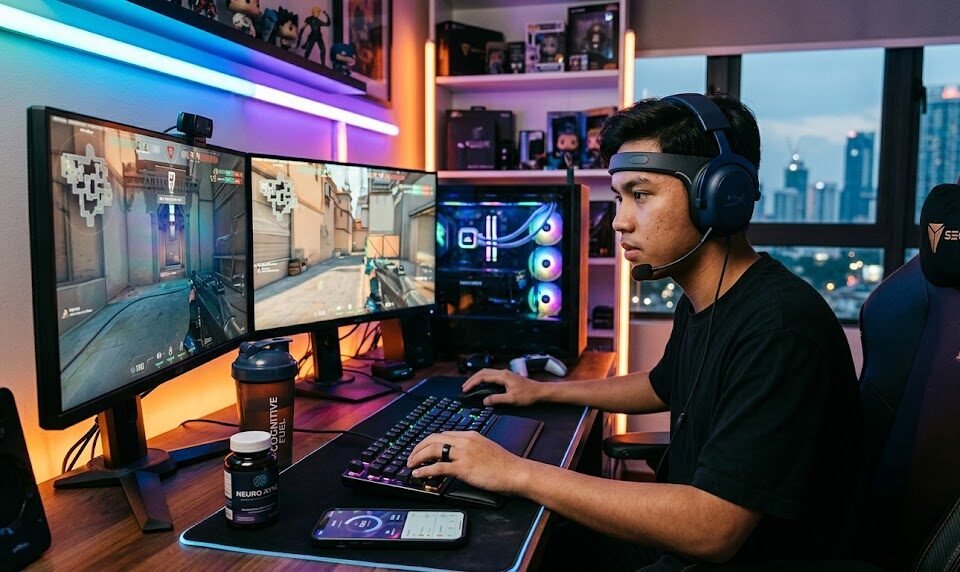
Improving gaming performance usually meant upgrading a graphics card, buying a faster monitor, or spending more hours practicing. Today, a growing number of gamers are focusing on something far more complex—the human brain itself.
During a recent gaming convention in Southeast Asia, conversations about reaction times and competitive rankings increasingly included discussions about sleep tracking, focus-enhancing technology, wearable devices, and cognitive optimization strategies.
The shift reflects a broader movement known as biohacking. Once associated with Silicon Valley entrepreneurs and health enthusiasts, biohacking is now finding an enthusiastic audience among gamers. Across Southeast Asia, players are investing in technologies and wellness tools designed to improve concentration, reaction speed, decision-making, and mental endurance.
What makes this trend particularly fascinating is that it sits at the intersection of gaming, health, technology, and performance science. As esports continues to professionalize and competitive gaming becomes more demanding, many players are treating cognitive performance as seriously as athletes treat physical fitness.
What Is Biohacking and Why Gamers Care
Biohacking is a broad term that refers to using science, technology, lifestyle adjustments, and data-driven strategies to optimize physical and mental performance.
For gamers, the goal is often straightforward: improve focus, reduce mental fatigue, react faster, and maintain consistency during long gaming sessions.
Unlike traditional fitness trends, gaming biohacking focuses heavily on cognitive performance. Players are interested in understanding how sleep quality, stress levels, nutrition, hydration, and brain activity affect in-game results.
The growing availability of consumer technology has made this process more accessible than ever before.
Instead of relying on guesswork, gamers can now collect real-time data about their bodies and habits.
The Rise of Cognitive Performance Technology
Technology companies have responded quickly to growing demand.
Modern gamers can choose from a variety of cognitive enhancement tools including:
- Sleep tracking devices
- Heart rate monitoring wearables
- Focus-training applications
- Meditation platforms
- Brain-training software
- Smart lighting systems
- Productivity analytics tools
These products promise to help users understand performance patterns and identify factors that affect mental sharpness.
For competitive players, even small improvements can make a meaningful difference.
In fast-paced esports titles where milliseconds determine outcomes, reaction speed and sustained focus are valuable competitive assets.
Why Southeast Asia Is Becoming a Growth Market
Southeast Asia has become one of the world’s most active gaming regions.
Countries such as Indonesia, Thailand, Vietnam, Malaysia, Singapore, and the Philippines have witnessed rapid growth in esports participation and gaming culture.
Several factors are accelerating biohacking adoption throughout the region:
- Increasing smartphone penetration
- Expanding esports ecosystems
- Growing middle-class spending power
- Higher awareness of wellness trends
- Greater access to wearable technology
Younger consumers are particularly receptive because they already embrace technology in many aspects of daily life.
For many gamers, tracking sleep or monitoring recovery feels like a natural extension of using gaming analytics.
Case Study: Competitive Gaming and Sleep Optimization
Consider a hypothetical amateur esports team preparing for a regional tournament.
Initially, players focus almost entirely on practice hours. However, coaches begin noticing performance inconsistencies despite extensive training.
The team introduces sleep monitoring tools.
Over several weeks, players discover that sleep quality directly influences reaction time, communication effectiveness, and decision-making accuracy.
Instead of simply increasing practice sessions, the team prioritizes consistent sleep schedules and recovery habits.
Performance metrics improve.
While this example is simplified, similar findings have emerged from sports science research. Mental performance often depends on factors outside direct skill training.
For gamers, understanding these variables can provide a competitive advantage.
Wearable Technology Enters the Gaming World
Wearables have become one of the most visible aspects of gaming biohacking.
Devices that track:
- Sleep cycles
- Heart rate variability
- Stress indicators
- Physical activity
- Recovery readiness
are increasingly marketed to performance-focused consumers.
Originally designed for fitness enthusiasts, these technologies are now attracting gamers who want measurable insights into cognitive performance.
Interestingly, many esports players report that improved lifestyle awareness leads to better gaming consistency.
The wearable becomes less about fitness and more about understanding personal performance patterns.
The Science Behind Mental Endurance
Gaming performance is often misunderstood.
Many people assume success depends entirely on mechanical skill. However, professional esports organizations increasingly recognize the importance of mental endurance.
High-level competition requires:
- Sustained concentration
- Rapid information processing
- Emotional control
- Strategic thinking
- Effective communication
These cognitive demands can last for hours during tournaments.
As a result, players are exploring methods traditionally used by athletes, executives, and performance professionals.
Biohacking technologies provide data that helps identify strengths and weaknesses within these areas.
Opportunity Table: The Growing Gaming Biohacking Market
| Opportunity Area | Benefit for Gamers | Industry Potential |
|---|---|---|
| Wearable Devices | Performance tracking | Growing hardware sales |
| Sleep Optimization | Improved recovery | Wellness technology expansion |
| Brain Training Apps | Cognitive improvement | Subscription-based revenue |
| Mental Wellness Platforms | Reduced stress | Digital health growth |
| Smart Gaming Setups | Enhanced focus environments | Gaming accessory innovation |
| Performance Analytics | Data-driven decisions | Esports coaching opportunities |
This table illustrates why multiple industries are becoming interested in gaming-focused biohacking.
The trend extends beyond individual consumers.
The Influence of Professional Esports
Professional esports organizations are helping normalize cognitive performance optimization.
Teams increasingly employ:
- Sports psychologists
- Performance coaches
- Nutrition advisors
- Wellness consultants
This mirrors developments seen in traditional sports decades earlier.
As audiences observe professional players discussing recovery routines and focus strategies, interest spreads throughout broader gaming communities.
Many aspiring competitors attempt to replicate these practices using consumer-grade technologies.
This creates demand for products specifically designed around gaming performance.
Social Media Accelerates Adoption
Platforms such as TikTok, YouTube, Instagram, and Twitch play a major role in spreading biohacking trends.
Gaming creators frequently share:
- Sleep optimization experiments
- Productivity routines
- Focus-enhancing setups
- Wellness challenges
- Performance tracking results
These stories often receive significant engagement because audiences enjoy seeing measurable outcomes.
The combination of gaming culture and self-improvement content has proven especially appealing to younger demographics.
As a result, biohacking has become both a wellness movement and a form of digital entertainment.
Challenges and Misconceptions
Despite growing enthusiasm, biohacking remains a complex topic.
One common misconception is that technology alone guarantees better performance.
In reality, most experts emphasize that foundational habits such as adequate sleep, balanced nutrition, regular exercise, and stress management remain the most important factors.
Technology primarily serves as a measurement and feedback tool.
Another challenge involves unrealistic expectations.
Some consumers seek instant improvements when meaningful cognitive gains often require long-term behavioral changes.
Successful biohacking tends to focus on consistency rather than shortcuts.
The Future of Cognitive Enhancement in Gaming
Looking ahead, the relationship between gaming and cognitive technology is likely to deepen.
Emerging innovations may include:
- AI-powered performance coaching
- Personalized wellness recommendations
- Advanced neurofeedback systems
- Adaptive gaming environments
- Integrated health-performance dashboards
As hardware becomes more sophisticated and data analysis improves, gamers will gain increasingly detailed insights into how their minds and bodies influence performance.
Southeast Asia is well positioned to participate in this evolution due to its rapidly growing gaming population and strong enthusiasm for technology adoption.
More Than a Gaming Trend
The rise of biohacking among gamers represents something larger than a niche wellness movement.
It reflects a cultural shift toward measurable self-improvement.
Modern players are no longer satisfied with optimizing only their devices. They want to understand and improve the human operating system behind the keyboard, controller, or smartphone.
As esports becomes more competitive and digital lifestyles continue expanding, cognitive performance technology will likely become a routine part of gaming culture.
For Southeast Asia’s rapidly growing gaming community, the future of competitive advantage may depend not only on faster processors and better graphics cards, but also on smarter approaches to mental performance, recovery, and well-being.
