

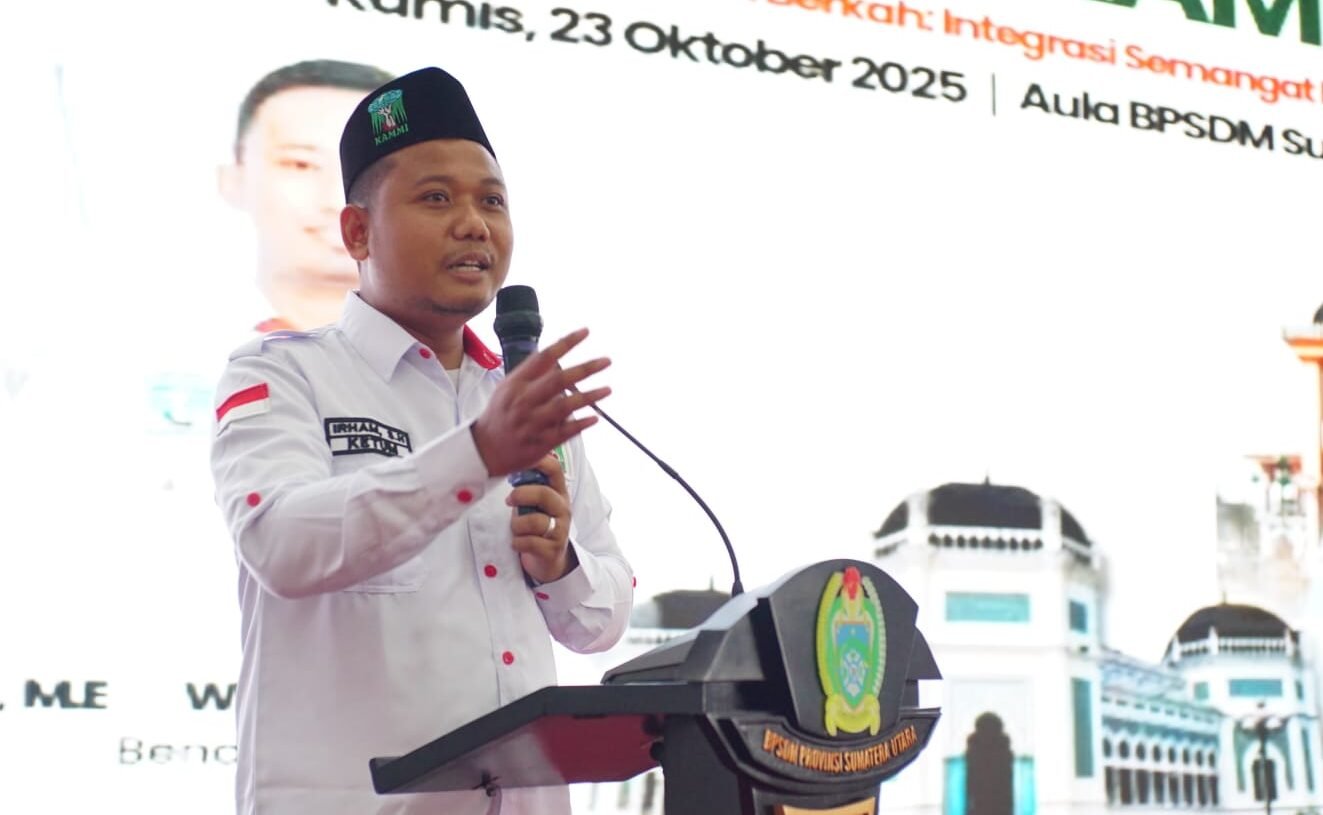
MEDAN, HALOSUMUT.COM – The Regional Leadership of the North Sumatra Muslim Students Action Front (PW KAMMI Sumut) has officially voiced strong support for the decisive stance taken by the Governor of North Sumatra regarding the recent massive power outage.
KAMMI publicly lauded the provincial government’s bold intervention in pressing state-owned electricity company PT PLN (Persero) to immediately take full institutional responsibility.
The student organization emphasizes that PLN must swiftly distribute formal compensation to millions of affected citizens across the province who suffered severe disruptions due to the widespread blackout.
The statements were issued following a critical evaluation by PW KAMMI Sumut regarding the management of regional energy infrastructure. The student activists pointed out that the recent power grid failure was not a minor technical glitch, but a systemic failure that paralyzed public activities for hours.
By aligning themselves with the Governor’s official reprimand, KAMMI emphasizes that public utilities must be held to a high standard of legal accountability under existing consumer protection frameworks.
In their official press release, KAMMI noted that the Governor’s firm stance represents the true voice of marginalized communities and small businesses who bear the brunt of unexpected utility failures.
The organization demands that PLN bypass complicated bureaucratic red tape and establish transparent, easily accessible mechanisms for calculating and distributing compensation, ensuring that the remedies directly reach residential consumers and micro-enterprises across all districts.
The prolonged blackout across North Sumatra has triggered severe economic and structural impacts. On a commercial level, thousands of Micro, Small, and Medium Enterprises (MSMEs)—particularly those in the food storage, digital services, and home-manufacturing sectors—faced instant revenue stagnation and physical asset damage due to the sudden power cuts.
On a larger scale, critical public infrastructure, including healthcare facilities, traffic control networks, and digital communication towers, experienced operational vulnerabilities, highlighting the fragile state of the regional power grid.
Furthermore, the repeating nature of these power crises damages public trust in state-owned enterprises. When a strategic region like North Sumatra experiences sudden, massive blackouts, it directly hurts local investment appeal.
International and domestic investors require a stable electricity supply as a basic foundation for industrial expansion; thus, frequent uncompensated outages create negative market sentiments that could slow down regional economic growth in the second quarter of 2026.
As an immediate solution to defuse public frustration, the management of PT PLN (Persero) Wilayah Sumut must immediately comply with Minister of Energy and Mineral Resources (ESDM) regulations regarding electricity indicators.
PLN needs to automatically apply a minimum 20% to 35% reduction on monthly electricity bills or provide equivalent prepaid token bonuses to all verified affected accounts in the next billing cycle.
For a long-term structural solution, the provincial government, in collaboration with central energy bodies, must conduct an independent technical audit of the Southern and Western Sumatra grid networks (Tol Listrik Sumatra). Investing heavily in automated backup systems, upgrading aging transformers, and accelerating the integration of regional renewable energy alternatives will distribute the power load more safely.
By modernizing the grid’s infrastructure and implementing automated compensation systems, North Sumatra can successfully prevent future catastrophic blackouts while guaranteeing a resilient, reliable, and consumer-friendly energy ecosystem.
