

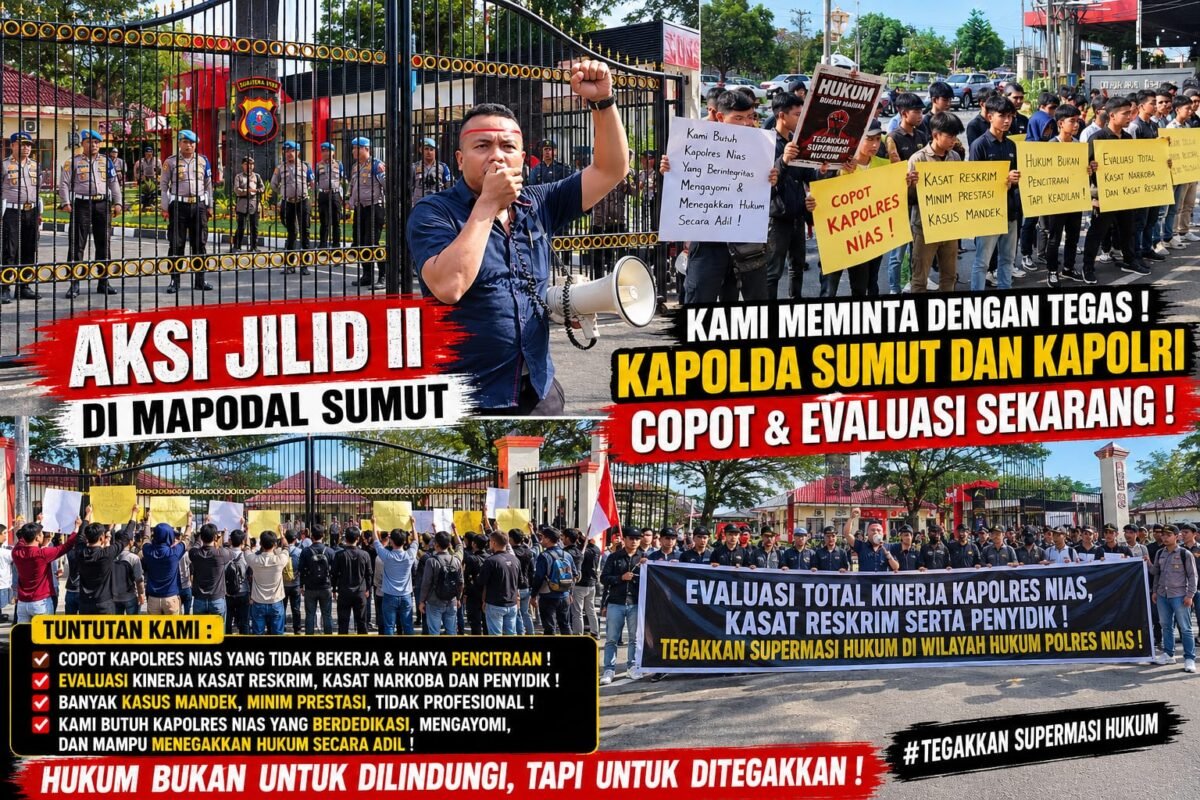
MEDAN, HALOSUMUT.COM – Tensions surrounding unresolved legal cases in Nias Island are escalating as the Central Leadership Board of the National Youth Movement Alliance (DPP PN) officially announced its readiness to launch a massive Phase II peaceful demonstration at the North Sumatra Regional Police Headquarters (Mapolda Sumut) in Medan.
This coordinated mass mobilization is a direct follow-up to their previous protests, aimed at pressuring the North Sumatra Police Chief (Kapolda Sumut) to immediately evaluate and reform the performance of the Nias Police (Polres Nias) over several stalled high-profile criminal investigations.
The DPP PN alliance explained that their return to the streets is driven by a profound lack of progress regarding various crucial cases handled by the Nias Police. Activists point out that multiple public reports—ranging from severe structural corruption allegations to stagnant domestic criminal cases—have languished in the local investigative pipeline for months without transparent updates or definitive legal closures, raising significant public skepticism regarding institutional integrity on the island.
In their official press statement, the leadership of DPP PN emphasized that the upcoming Phase II action will deploy a substantially larger mass of protesters to ensure their voices are heard by high-ranking regional officials.
The alliance demands not only the immediate acceleration of these stalled cases but also a comprehensive structural evaluation of the Nias Police Chief (Kapolres Nias) and his lead investigators, whom the group deems ineffective in upholding standard operational procedures and delivering swift justice to the local community.
This looming mass demonstration at Mapolda Sumut carries significant legal and social structural impacts. From an institutional standpoint, the persistent complaints from civil alliances put heavy pressure on the public image of the Indonesian National Police (Polri), specifically the Presisi (Predictive, Responsible, and Fair Transparency) framework championed by the police leadership.
When local police sectors fail to resolve public grievances efficiently, it creates a severe crisis of confidence among grassroots communities on Nias Island, leading to the perception that legal equity is inaccessible without public outrage.
Furthermore, from a regional security perspective, mobilizing hundreds of protesters from various districts to gather at the provincial police headquarters on Jalan Sisingamangaraja, Medan, requires meticulous traffic and security management.
If the demonstration encounters bureaucratic roadblocks or communication breakdowns, it risks causing major traffic gridlock along vital economic routes in Medan and could trigger localized physical friction, transforming a localized legal grievance into a broader provincial security concern.
As an immediate solution to de-escalate the situation and prevent a chaotic mass confrontation, the Internal Affairs Division (Propam Mapolda Sumut) must step in forcefully. Kapolda Sumut should immediately deploy an independent supervisory team to Polres Nias to conduct a comprehensive performance audit and inspect the case progression files (SP2HP).
By forcing local investigators to provide transparent, audit-proof status updates to the public, regional authorities can effectively address the core grievances of the protesters.
Concurrently, the leadership of the DPP PN alliance should utilize official, structured communication channels alongside their public street actions. Submitting a detailed, legally backed dossier of the stalled cases directly to the Inspectorate of Regional Supervision (Itwasda) will enable a formal institutional review under Indonesian police regulations.
By establishing a transparent bipartite dialogue between Mapolda Sumut representatives and the student-youth alliance, the region can safely achieve legal clarity, restore institutional accountability, and maintain social harmony across North Sumatra.
