

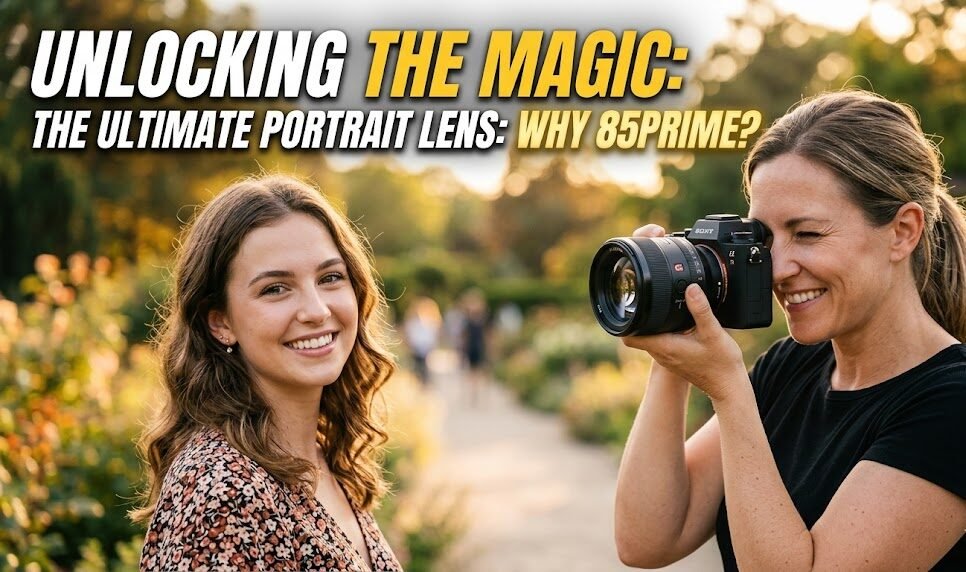
MEDAN, HALOSUMUT EN – In the world of visual storytelling, choosing the right gear is just as critical as the subject itself. For portrait photographers aiming to capture that professional, high-end look, one focal length consistently stands above the rest: the 85mm prime lens.
Known as the “king of portraiture,” this lens offers a unique blend of compression and clarity that transforms a simple photo into a work of art.
The 85mm lens is prized primarily for its ability to produce a shallow depth of field. When shooting at wide apertures like $f/1.8$ or $f/1.4$, the lens creates a creamy, smooth background blur—mathematically referred to as bokeh. This physical property allows the subject to pop perfectly against a non-distracting backdrop.
Furthermore, the 85mm focal length provides a “natural” compression. Unlike wide-angle lenses that can distort facial features (making noses appear larger or ears smaller), the 85mm renders human proportions accurately and flatteringly.
Using an 85mm lens significantly impacts the emotional resonance of an image. Because the photographer must stand a few meters away from the subject, it creates a comfortable “personal space” buffer. This distance often helps models feel less intimidated, resulting in more candid and relaxed expressions.
In the competitive market of digital media and branding, the “85mm look” is often associated with premium editorial content. For creators building a visual identity, these sharp, compressed images provide a level of polish that kit lenses simply cannot replicate.
While powerful, the 85mm lens comes with its own set of hurdles, particularly camera shake. Due to the longer focal length, even slight hand movements can cause blur.
Photographers should follow the “reciprocal rule,” ensuring their shutter speed is at least $1/100$ of a second or faster. Additionally, many modern 85mm lenses now come equipped with Optical Image Stabilization (OIS) or rely on In-Body Image Stabilization (IBIS) to ensure tack-sharp results even in lower lighting conditions.
Beyond the technical specs, mastering the 85mm requires an understanding of environment. Because of its narrow field of view, this lens is ideal for outdoor sessions or large studio spaces. In tight indoor settings, you may find yourself literally backed against a wall.
For those transitioning from zoom lenses, the “limitation” of a fixed focal length actually fosters creativity. It forces the photographer to move their body to find the best angle, rather than relying on a zoom ring. This physical engagement with the scene often leads to better composition and more thoughtful framing.
