

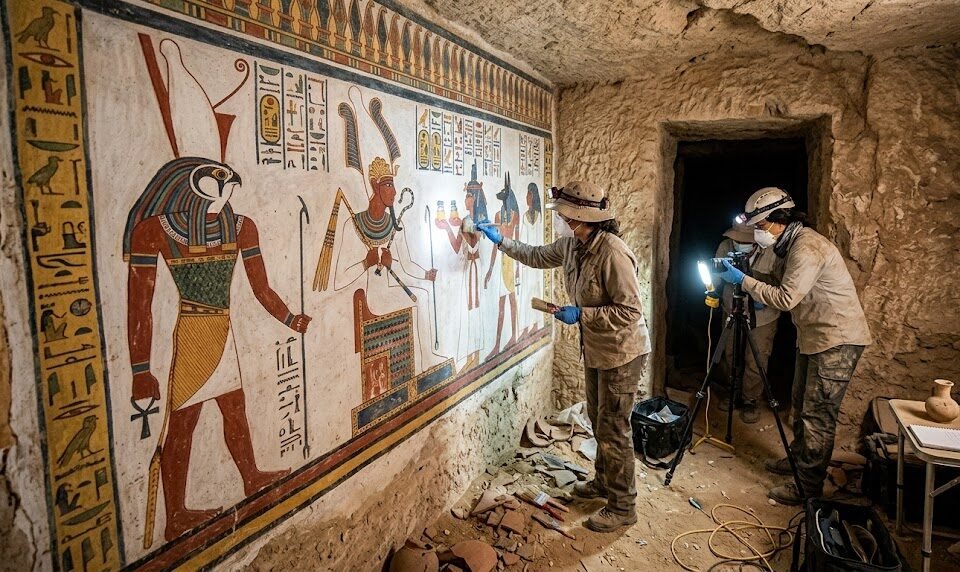
CAIRO, HALOSUMUT.COM – In a monumental breakthrough that has sent waves of excitement through the global scientific community, an international team of archaeologists working in Egypt has successfully uncovered a stunningly well-preserved ancient tomb.
The remarkable structural discovery is heavily distinguished by its exceptionally vivid, colorful wall paintings, which have managed to remain incredibly intact despite the passage of thousands of years.
The official excavation project, which was carried out under strict regulatory frameworks and meticulous scientific monitoring, led to the unearthing of a burial chamber belonging to a high-ranking official from Egypt’s historic Old Kingdom period.
The discovery offers a rare, highly detailed, and transparent window into the artistic mastery, social stratification, and religious customs of one of antiquity’s most fascinating civilizations.
What makes this specific discovery extraordinarily unique is the pristine state of the ancient pigments used on the chamber walls.
The beautifully detailed artwork illustrates a diverse array of daily life scenes, including large-scale agricultural harvesting activities, complex boat-building techniques, traditional musical performances, and elaborate ritualistic offerings presented to the deities of the ancient world.
In an official statement released by the Ministry of Tourism and Antiquities, leading experts expressed their immense astonishment at the sheer quality of the preservation.
The structural integrity of the tomb combined with the vibrant state of the paintings will provide historians and researchers with invaluable, non-degraded data to systematically re-evaluate regional artistic styles and socio-political structures of the era.
“Finding a tomb of this age with its original colors still so brilliantly defined is a rare and profound occurrence in modern archaeology.
This discovery does not merely enrich our museum collections; it structurally deepens our collective understanding of human civilization and the sophisticated craftsmanship of the ancestors,” a senior archeological director stated with deep conviction.
The excavation site has now been placed under maximum security and strict environmental control to shield the delicate artifacts and wall paintings from atmospheric degradation and external elements.
The international research team is currently preparing to utilize advanced digital scanning technologies and non-invasive chemical analysis to further study the inscriptions without compromising the physical artwork.
The unveiling of this Old Kingdom tomb marks a highly strategic achievement for Egypt’s ongoing cultural revitalization and tourism recovery framework. The Old Kingdom, often referred to by historians as the “Age of the Pyramids,” represents a dynamic era of centralized political authority and unprecedented architectural expansion.
By discovering unlooted or perfectly sealed chambers from this specific epoch, global Egyptologists can piece together the complex economic logistics and administrative networks that allowed local provincial governors to accumulate immense wealth and maintain elite artists within their regional courts.
From a global heritage perspective, this discovery highlights the evolving role of advanced conservation science in preserving highly sensitive sub-surface historical sites.
Modern archeological teams are increasingly shifting away from aggressive physical excavation toward dynamic digital preservation, ensuring that fragile organic pigments are structurally stabilized before being exposed to ambient air and humidity.
Cultural observers note that the global dissemination of these high-definition historical findings plays an essential role in fostering international educational exchanges, inspiring grassroots historical societies worldwide to protect and treasure their localized ancestral heritages.
