

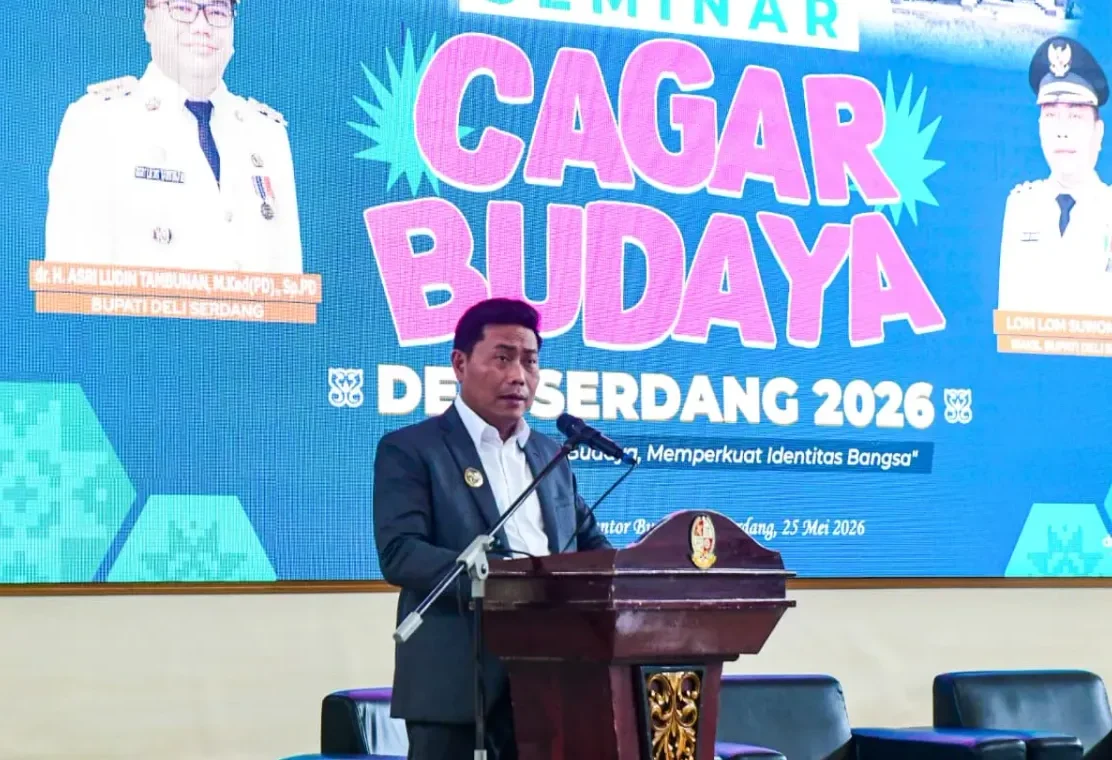
DELI SERDANG, HALOSUMUT.COM – The Vice Regent of Deli Serdang, Lom Lom Suwondo, SS, strongly emphasized the critical importance of safeguarding cultural heritage as a fundamental effort to maintain the region’s distinctive identity amid the sweeping waves of rapid infrastructure development and modernization.
This statement was formally delivered during his opening remarks at the 2026 Deli Serdang Regency Cultural Heritage Seminar, which took place at the Cendana Hall, 2nd Floor of the Deli Serdang Regent’s Office, on Monday (25/5/2026).
SEE ALSO >>> Deli Serdang PMD Attends Halal Slaughtering Dialogue and Training for Free Nutritious Meal Program
The seminar, which successfully carried the profound theme “Caring for Cultural Heritage, Strengthening National Identity,” served as a strategic academic forum and a cross-sectoral coordination space to formulate comprehensive preservation frameworks for cultural heritage assets in the face of rapidly accelerating modern developments.
In his official speech, Lom Lom conveyed that cultural preservation represents a vital and necessary undertaking to shield the local identity and cultural character of the Deli Serdang community from being completely eroded by modern societal shifts.
“We are actively carrying out this initiative so that the younger generation in Deli Serdang Regency will never forget their historical roots, traditional values, spiritual values, cultural characteristics, and even the economic values inherited by our ancestors. Cultural preservation plays a major role in building a society that is healthy, intelligent, religious, and sustainable,” he firmly stated.
He further pointed out that cultural heritage assets must never be viewed merely as obsolete buildings or static relics from the past; rather, they serve as living symbols of history, struggle, civilization, identity, and the collective soul of the community that must be mutually protected.
On that significant occasion, he reaffirmed that the Deli Serdang Regency Government remains fully committed to executing protective and preservation measures for local cultural sites and historical potentials through various structured phases, ranging from initial assessments, feasibility studies, and documentation, to the systematic collection of authentic evidence.
“Through this seminar, we highly expect the birth of strategic recommendations and valuable insights from academics, cultural experts, religious figures, and the general public to serve as a solid foundation in maintaining and protecting our cultural heritage in Deli Serdang Regency,” he explained.
Lom Lom Suwondo also openly acknowledged that Deli Serdang Regency actually holds an abundance of cultural potential and historical sites that have recently begun to fade from public memory, thereby putting them at a high risk of suffering from a severe degradation of cultural and historical value.
Several notable objects suspected of holding cultural heritage status that were thoroughly scrutinized during the seminar included the Rumah Datuk Ong in Pagar Merbau District, the Rumah Kedatukan in Batang Kuis District, the Javanese Christian Church (GKJ) in Desa Kolam, the Naga Hijau Temple in Pantai Labu District, the Tomb of the Sultan of Deli (Gocah Pahlawan), and the Benteng Tanduk Benua.
“The existence of these historic sites clearly demonstrates that since ancient times, Deli Serdang has consistently grown as a region immensely rich in cultural values, tolerance, trade, customs, and multicultural community life. This represents a monumental collective strength that must be proudly passed down to our younger generation,” he added.
Through a solid and synergistic cooperation involving the local government, the Cultural Conservation Center (BKP), academic institutions, and the grassroots community, it is highly expected that the long-term sustainability of the regional cultural heritage can be successfully maintained.
“A significant number of historical buildings and cultural sites have began to deteriorate due to aging and modern developments. This brings us a deep sense of sorrow, but at the same time, it stands as a collective challenge for all of us to proactively protect and preserve them,” he expressed emotionally.
Meanwhile, the Head of the Culture, Youth, Sports, and Tourism Department of Deli Serdang Regency, Yudy Hilmawan, stated that the seminar was intentionally organized to serve as an academic discussion room and a cross-sectoral coordination hub to formulate cultural heritage preservation strategies, while simultaneously elevating public awareness regarding objects suspected of being cultural heritage in the Deli Serdang administrative area.
He further elaborated that the seminar aimed to accurately identify the existing potentials and underlying challenges in rescuing objects suspected of being cultural heritage, build a cohesive synergy between the government, academics, cultural communities, and the public in cultural heritage monitoring, and formulate policy recommendations regarding the utilization of cultural heritage for sustainable education and tourism sectors.
In addition to officially launching the event, the Vice Regent of Deli Serdang, Lom Lom Suwondo, SS, also actively participated as a prominent keynote speaker in the seminar, alongside Prof. Dr. Suprayitno and Dr. Fikarwin Zuska, in a panel session smoothly guided by Dr. Edi Sumarno as the moderator.
The seminar saw an extensive turnout of participants, consisting of representatives from regional government agencies (OPD), PTPN IV Regional II, sub-district heads (Camat), village heads (Kepala Desa), managers of objects suspected of being cultural heritage, traditional community leaders, local citizens, as well as the Expert Team and the Cultural Heritage Registration Team of Deli Serdang Regency.
Deli Serdang Regency occupies a historically significant position within the cultural landscape of North Sumatra, heavily influenced by the legacies of the Deli Sultanate, Malay traditions, and the harmonious integration of multicultural ethnic groups including Batak, Javanese, Chinese, and Indian communities.
The presence of iconic historical sites discussed in the seminar, such as the Tomb of Gocah Pahlawan (the revered founder of the Deli Sultanate) and the multicultural architectural marvels across Pantai Labu and Batang Kuis, showcases how the region served as a vital hub for global trade, diplomacy, and religious tolerance centuries ago.
In recent years, local cultural activists have raised concerns over the rapid conversion of historic landscapes into industrial zones and modern commercial estates, which threatens unregistered historical structures. By establishing a dedicated Cultural Heritage Registration Team and engaging corporate entities like PTPN IV, the Deli Serdang administration aims to integrate heritage preservation into the regional spatial planning (RTRW).
This initiative is expected to pave the way for sustainable cultural tourism, transforming historical landmarks into educational centers that generate alternative economic opportunities for village communities.
