

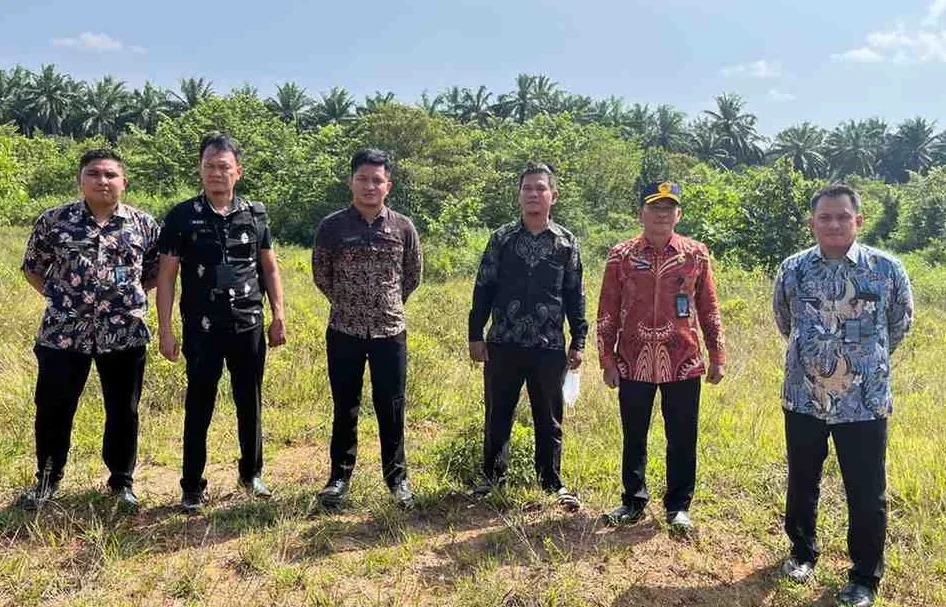
LABUHANBATU SELATAN, HALOSUMUT.COM – In a proactive move to upgrade regional state infrastructure and improve inmate rehabilitation frameworks, the Head of the Kotapinang Correctional Institution (Kalapas Kotapinang) officially conducted an on-site inspection of a newly allocated land plot in Asam Jawa Village, Torgamba District, Labuhanbatu Selatan Regency.
This strategic site survey serves as a vital foundational step in supporting the Ministry of Law and Human Rights’ (Kemenkumham) long-term master plan to expand and modernize regional correctional facilities.
The institutional inspection was led directly by the Kalapas team alongside structural officers, surveying the geographical boundaries and technical feasibility of the land.
The acquisition of this new asset is a direct result of strong, synergistic coordination between the Lapas Kotapinang administration and the Regional Government of Labuhanbatu Selatan, which aimed to secure legal land grants that comply with state construction standards.
During the field assessment, the Kalapas Kotapinang delegation evaluated several logistical parameters, including road accessibility, water source proximity, and overall environmental security. The technical team explained that the raw land will undergo a series of administrative processing and land-clearing phases before actual structural blueprints can be executed.
This comprehensive preparation ensures that future building developments will fully satisfy standard prison security protocols and human rights optimization codes.
This infrastructural initiative brings a significant, positive structural impact to the legal enforcement landscape and social order of North Sumatra. From an institutional standpoint, developing a new, larger facility directly addresses the chronic issue of overcapacity that routinely challenges regional prisons across the province.
Providing spacious, well-segregated blocks allows correctional officers to maintain maximum security control, significantly reducing the risk of prison riots, inmate friction, or unauthorized escapes.
From a humanitarian and rehabilitation perspective, expanding physical facilities creates ample space for modern inmate empowerment programs. Instead of suffering in congested cells, inmates can be enrolled in spacious vocational workshops—such as agricultural farming, wood craftsmanship, and digital literacy classes.
This constructive environment successfully prepares inmates for smooth social reintegration, dropping regional recidivism rates and transforming former offenders into productive, law-abiding citizens upon their release.
As an immediate solution to accelerate this development roadmap, the Lapas Kotapinang management and the local government must immediately form an accelerated administrative task force. This team will focus on finalizing land certification (sertifikasi lahan) through the National Land Agency (BPN) to prevent any future agrarian disputes or boundary overlaps with neighboring community estates.
For a long-term structural solution, the upcoming building architecture should be designed as an eco-friendly, integrated correctional complex (Lapas Industri). Incorporating green energy sources, modern waste-management setups, and secure digital biometric monitoring networks will ensure high-yield operational efficiency.
By establishing consistent, phase-by-phase budgetary transparency and maintaining open communication with the regional Kemenkumham office, Lapas Kotapinang can successfully build a model correctional facility that guarantees absolute public safety and progressive human rehabilitation throughout Labuhanbatu Selatan.
To understand the critical urgency behind the land inspection in Asam Jawa Village, it is essential to look at the broader, systemic challenges currently facing correctional institutions across North Sumatra:
The Density Dilemma: North Sumatra consistently ranks among the provinces with the highest inmate populations in Indonesia, driven heavily by intense law enforcement crackdowns on narcotics trafficking. Many existing facilities house inmates at double or triple their intended design capacity, placing immense physical strain on older building infrastructures and security personnel.
The Shift to Human Rights-Based Detention: Modern Indonesian correctional policies are rapidly shifting away from purely punitive isolation toward holistic, skill-based rehabilitation. Expanding regional land assets, such as this latest project by Lapas Kotapinang, is highly necessary to provide the actual physical space required to build proper medical clinics, religious worship centers, and agricultural training fields that meet international standard minimum rules for the treatment of prisoners.
