

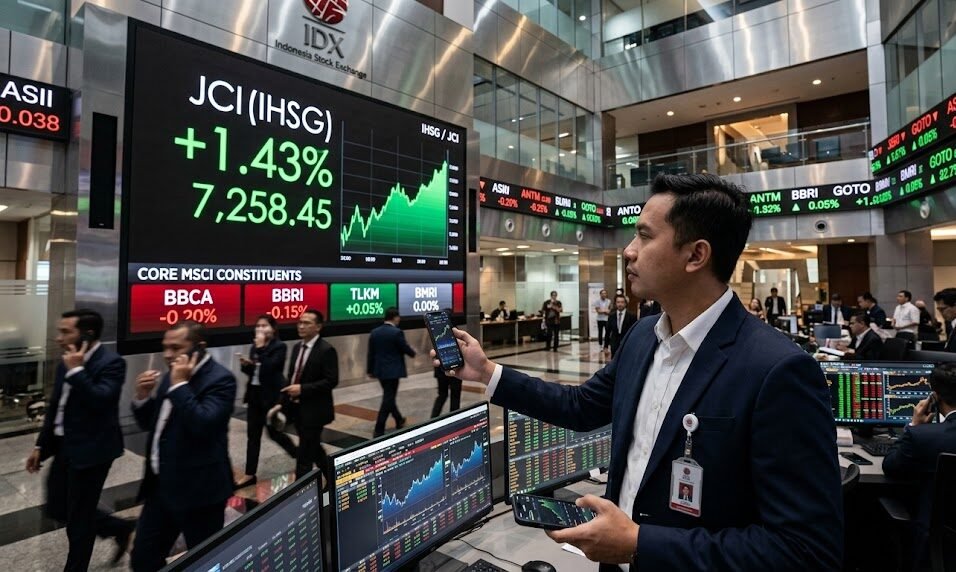
JAKARTA, HALOSUMUT.COM – The Jakarta Composite Index (JCI) logged a significant rebound at the closing of trading on Wednesday, April 3, 2024, closing up 1.43% or gaining 101.37 points to finish at the level of 7,243.83. This positive closing represents a vital recovery momentum following structural corrections seen in the preceding trading cycles.
Market capitalization expanded broadly across the bourse, scaling up to IDR 11,878 trillion. Concurrently, investor trading enthusiasm surged significantly, with cumulative trading transaction volume hitting 17.06 billion shares changing hands, posting a massive consolidated transaction value of IDR 12.35 trillion across the trading day.
A closer look at internal index breadth showed that stock gainers heavily dominated market mechanics. A total of 332 stock counters finished trading in positive territory, soundly outpacing 246 stocks that declined, while another 213 counters remained completely flat and unchanged from their previous positions.
Despite the JCI’s robust upward momentum, foreign institutional investors paradoxically maintained a heavy net sell stance, recording a total net capital outflow of IDR 1.83 trillion across all market boards.
This persistent sell-off was heavily concentrated in prime banking and mining giants that populate the prestigious Morgan Stanley Capital International (MSCI) index ecosystem.
Leading the foreign liquidation list was PT Bank Central Asia Tbk (BBCA), which saw a substantial foreign net sell of IDR 627.5 billion, causing its share price to soften by 1.02% to settle at IDR 9,725 per share. It was closely followed by state-owned banking titan PT Bank Rakyat Indonesia (Persero) Tbk (BBRI), hitting a foreign net sell of IDR 579.5 billion as its share value fell 1.76% to close at IDR 5,575 per share.
Furthermore, copper and gold mining heavyweight PT Amman Mineral Internasional Tbk (AMMN) was subjected to an aggressive foreign exit, booking a net sell of IDR 209.6 billion, pushing its share price down by 1.69% to close at IDR 8,725 per share.
Similarly, telecom giant PT Telkom Indonesia (Persero) Tbk (TLKM) registered a foreign net sell of IDR 184.2 billion, though it bucked the trend by gaining 0.58% to end at IDR 3,460 per share, while state lender PT Bank Mandiri (Persero) Tbk (BMRI) absorbed IDR 157.9 billion in foreign net selling, sliding 1.46% to close at IDR 6,750 per share.
The dichotomy between a surging domestic index and a concurrent massive capital flight by foreign fund managers highlights a changing structural dynamic within the Indonesia Stock Exchange (BEI).
Market analysts indicate that index rebalancing actions within global benchmark tracking mechanisms, such as the Morgan Stanley Capital International (MSCI) indices, often prompt massive block trades and programmatic liquidations that run contrary to broader retail and domestic institutional sentiment.
Historically, heavy weights within the MSCI Indonesia index—particularly elite tier-1 banking institutions such as BBCA, BBRI, and BMRI—experience systematic volatility during capital reallocation phases across emerging markets.
Local institutional buyers, including domestic pension funds, insurance assets, and state wealth managers, capitalized on the discounted pricing of these fundamentally sound equities on this trading day, effectively soaking up the immense foreign selling pressure and driving the index back above critical support thresholds.
From a wider macroeconomic vantage point, such movements within the Indonesian capital markets are closely tied to external monetary factors.
Fluctuations in the global economic landscape, particularly adjustments in the US Federal Reserve’s interest rate outlook and regional currency pressures against the US Dollar, frequently trigger defensive offloading behaviors among global portfolio managers.
Nevertheless, the underlying strong corporate earnings and financial resilience of these top-tier Indonesian corporations continue to serve as a strong baseline buffer against sustained systemic declines.
