

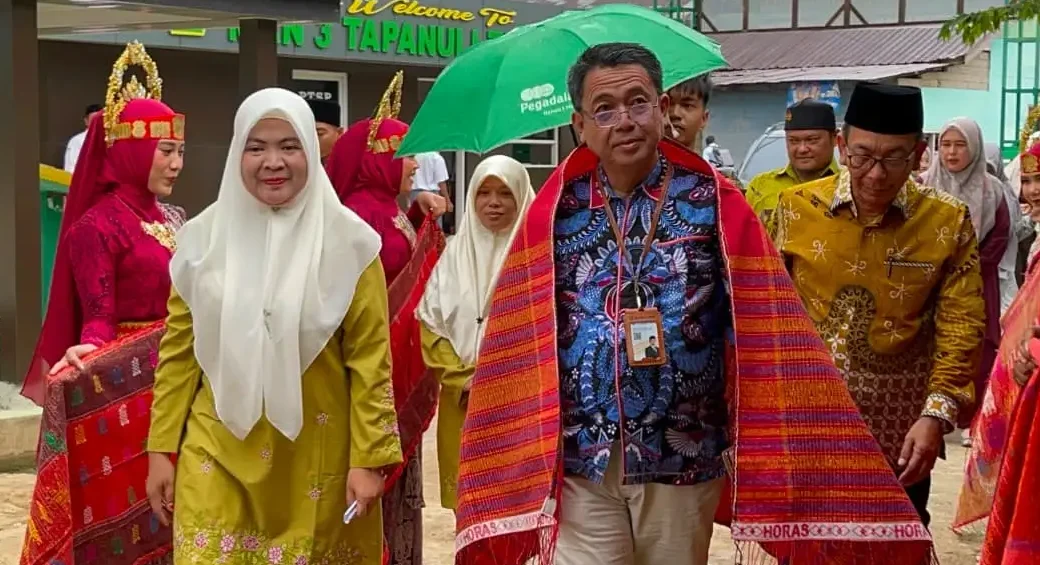
PANDAN, HALOSUMUT.COM – In a strategic step to continuously elevate academic quality and institutional accountability, the academic community of the Islamic High School (STAI) Bahriyatul Ulum Pandan, located in Central Tapanuli Regency, formally welcomed the official assessor team from the Independent Accreditation Agency for Education (Lembaga Akreditasi Mandiri Kependidikan – LAMDIK).
The visit was explicitly conducted in the framework of the field assessment for the reaccreditation of the Islamic Education (PAI) Bachelor’s Degree study program.
The grand welcoming ceremony, which took place with deep institutional pride and cultural warmth, was directly attended by the structural leadership of STAI Bahriyatul Ulum Pandan, the head of the PAI study program, dedicated lecturers, administrative staff, as well as student representatives who enthusiastically participated in supporting this vital academic milestone.
The LAMDIK assessor team, consisting of prominent and highly respected senior academics in the field of national Islamic education, arrived at the campus to carry out a comprehensive, transparent, and rigorous physical verification of the study program’s operational standard, educational infrastructure, curriculum structure, and overall academic performance metrics.
In his official welcoming speech, the Chairman of STAI Bahriyatul Ulum Pandan expressed his immense gratitude for the arrival of the assessors. He strongly emphasized that this field assessment is not merely a bureaucratic formality, but serves as an essential strategic momentum to evaluate, improve, and systematically scale up the quality of Islamic higher education in the West Coast region of North Sumatra.
“We have thoroughly prepared all the necessary data, self-evaluation reports, and physical evidence required for this assessment. We are fully open to receiving constructive guidance and strategic evaluations from the honorable assessors to ensure that our Islamic Education program continues to graduate high-caliber educators who can compete nationally,” the campus leadership stated firmly.
During the field assessment process, the LAMDIK assessor team actively engaged in rigorous document verification, structured interviews with internal and external stakeholders—including students, alumni, and user partners—and a direct physical inspection of campus facilities such as the digital library, micro-teaching laboratories, and lecturing rooms.
The entire academic community of STAI Bahriyatul Ulum Pandan highly expects that through this meticulous accreditation phase, the Islamic Education (PAI) study program will successfully secure a highly prestigious accreditation tier. This achievement will undoubtedly reinforce public trust and strengthen the institution’s position as a premier center for Islamic educational development.
STAI Bahriyatul Ulum Pandan holds a historically significant position as one of the pioneer Islamic higher education institutions in Central Tapanuli (Tapanuli Tengah). Geographically situated along the western coastline of North Sumatra, the campus has consistently played a vital role in providing affordable, high-quality spiritual and academic education to rural and coastal communities.
The Islamic Education (PAI) program remains the absolute backbone of the institution, consistently producing skilled religion teachers and community leaders who fill the educational vacuum across the region’s sub-districts and religious centers.
The transition of the accreditation process from the National Accreditation Board for Higher Education (BAN-PT) to independent specialized agencies like LAMDIK marks a new era of strict quality standards for educational programs in Indonesia.
For regional institutions like STAI Bahriyatul Ulum Pandan, meeting these updated criteria requires constant investment in lecturer research, community service programs (Pengabdian Kepada Masyarakat), and digital infrastructure integration.
Local education observers in North Sumatra note that a higher accreditation rating for this program will not only elevate the campus’s prestige but will also grant its graduates stronger advantages in the highly competitive national civil servant (CPNS) and professional teacher certification (PPG) selection processes.
