

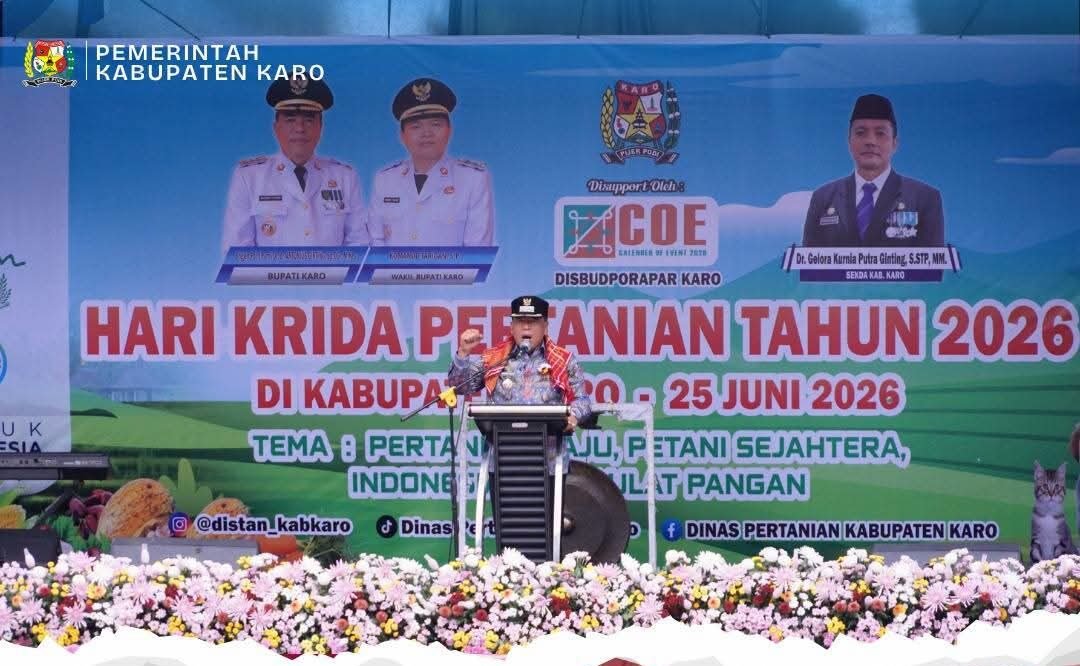
KABANJAHE – The Karo Regency Government commemorated Agriculture Day (Hari Krida Pertanian) 2026 on Thursday, June 25, at the Karo Regency DPRD Courtyard and Kabanjahe City Park, highlighting the region’s continued commitment to strengthening food security and improving the welfare of farmers.
The annual celebration, which is also included in the region’s Calendar of Events (COE), brought together government officials, agricultural stakeholders, farmers, educators, business representatives, and members of the local community to celebrate the achievements of Karo’s agricultural sector while outlining future development priorities.
Karo Regent Brig. Gen. (Ret.) Dr. dr. Antonius Ginting, Sp.OG., M.Kes., accompanied by Deputy Regent Komando Tarigan, S.P., attended the event and reaffirmed the administration’s commitment to building a modern, competitive, and sustainable agricultural industry.
More Than a Ceremony
In his keynote address, the Regent emphasized that Agriculture Day represents more than an annual ceremonial event.
Instead, it serves as an expression of appreciation for farmers, livestock breeders, agricultural extension officers, farmer groups, researchers, entrepreneurs, and every stakeholder whose dedication has helped maintain regional food security while supporting the local economy.
He noted that agriculture remains the backbone of Karo Regency, making continuous investment and innovation in the sector essential for long-term economic resilience.
Advancing Modern Agriculture
Carrying the theme “Advanced Agriculture, Prosperous Farmers, Food Sovereign Indonesia,” the 2026 celebration reflected a shared commitment to building an agricultural sector that is productive, innovative, environmentally sustainable, and capable of improving farmers’ livelihoods while contributing to Indonesia’s national food sovereignty.
According to the Regent, Karo’s fertile volcanic soil, favorable climate, and experienced farming communities position the regency as one of North Sumatra’s most important food-producing regions.
These advantages provide a strong foundation for expanding agricultural production while maintaining product quality and competitiveness.
Strategic Programs to Strengthen Agriculture
To support long-term agricultural development, the Karo Regency Government continues implementing several strategic initiatives.
These include:
- Expanding premium horticultural production areas
- Improving crop productivity and quality
- Strengthening livestock development and animal health services
- Modernizing agricultural machinery and farming equipment
- Enhancing farmer institutions and cooperatives
- Developing downstream agricultural industries
- Expanding agricultural marketing networks
- Encouraging partnerships between farmers, cooperatives, businesses, and investors
Officials believe these programs will improve efficiency throughout the agricultural value chain while creating more sustainable income opportunities for farming communities.
Strengthening Collaboration Despite Budget Constraints
Although regional budget limitations remain a challenge, the local government reaffirmed its commitment to advancing agriculture through stronger cooperation with Indonesia’s central government and relevant ministries.
Such collaboration is expected to accelerate investment in:
- Agricultural infrastructure
- Modern farming equipment
- Irrigation development
- Human resource capacity building
- Agricultural innovation programs
The administration hopes these partnerships will further increase productivity and support long-term food security objectives.
Partnerships Are Key to Farmer Success
The Regent stressed that farmers cannot succeed in isolation.
He emphasized the importance of strong partnerships involving government institutions, financial organizations, cooperatives, agricultural businesses, technology providers, and private investors.
Such cooperation should cover every stage of agricultural production—from access to farming inputs and financing to technological assistance and market access—allowing farmers to operate with greater certainty and improved profitability.
Encouraging the Next Generation of Farmers
One of the key messages delivered during the celebration was directed toward young people.
The Regent encouraged younger generations to view agriculture as an attractive career with significant growth potential.
Modern farming increasingly relies on digital technology, precision agriculture, smart irrigation systems, data-driven decision-making, and entrepreneurship.
These innovations are creating opportunities for a new generation of tech-savvy farmers capable of increasing productivity while strengthening the competitiveness of Karo’s agricultural products in domestic and international markets.
Appreciation for National and Regional Support
During the event, the Karo Regency Government expressed appreciation to the Indonesian Central Government, the Ministry of Agriculture, the Indonesian National Armed Forces (TNI), the National Police (Polri), the Karo Regional House of Representatives (DPRD), business communities, universities, financial institutions, and various organizations that have consistently supported agricultural development throughout the region.
Their continued cooperation has contributed significantly to strengthening the agricultural sector and improving rural livelihoods.
A Festival Celebrating Agriculture
Agriculture Day 2026 was accompanied by a wide range of educational and community activities designed to promote agricultural innovation while encouraging public participation.
Visitors enjoyed:
- Fruit and vegetable competitions
- Agricultural knowledge quizzes
- Sheep competitions across several categories
- Integrated agriculture drawing contests for elementary school students
- Eco-enzyme video competitions for junior high school students
- Pet contests
- Agricultural exhibitions
- Free soil nutrient and pH testing
- Demonstrations on producing Trichoderma biological disease-control agents
- Biochar soil improvement workshops
- Free agricultural, livestock, and veterinary consultation services
- Affordable agricultural product markets
- Culinary MSME exhibitions
- Property tax payment programs supported by Bank Indonesia with prize incentives
These activities highlighted the importance of combining education, innovation, and community engagement to strengthen the agricultural sector.
Agriculture Remains Central to Indonesia’s Food Security
Agriculture continues to play a strategic role in Indonesia’s national development agenda.
As global challenges such as climate change, supply chain disruptions, and rising food demand intensify, local food-producing regions like Karo are becoming increasingly important.
Experts note that investments in sustainable farming practices, agricultural technology, and farmer education are essential to maintaining long-term food resilience while improving rural economic growth.
Programs encouraging precision farming, digital marketplaces, and climate-smart agriculture are expected to become even more significant over the coming years.
Through Agriculture Day 2026, the Karo Regency Government reaffirmed its determination to build an agricultural sector that is resilient, innovative, and globally competitive.
By strengthening collaboration among farmers, government agencies, businesses, academic institutions, and financial partners, local authorities hope to create lasting improvements in productivity, farmer welfare, and regional food security.
As agriculture continues evolving through technology and sustainable practices, Karo aims to maintain its position as one of North Sumatra’s leading agricultural regions while contributing to Indonesia’s broader vision of achieving national food sovereignty.
Karo’s Agricultural Development Priorities
| Priority Area | Development Focus |
|---|---|
| Horticulture | High-value fruit and vegetable production |
| Livestock | Animal health and productivity improvement |
| Farm Mechanization | Modern agricultural equipment |
| Farmer Institutions | Cooperative strengthening and training |
| Market Expansion | Downstream processing and marketing |
| Youth Agriculture | Digital farming and agripreneurship |
