

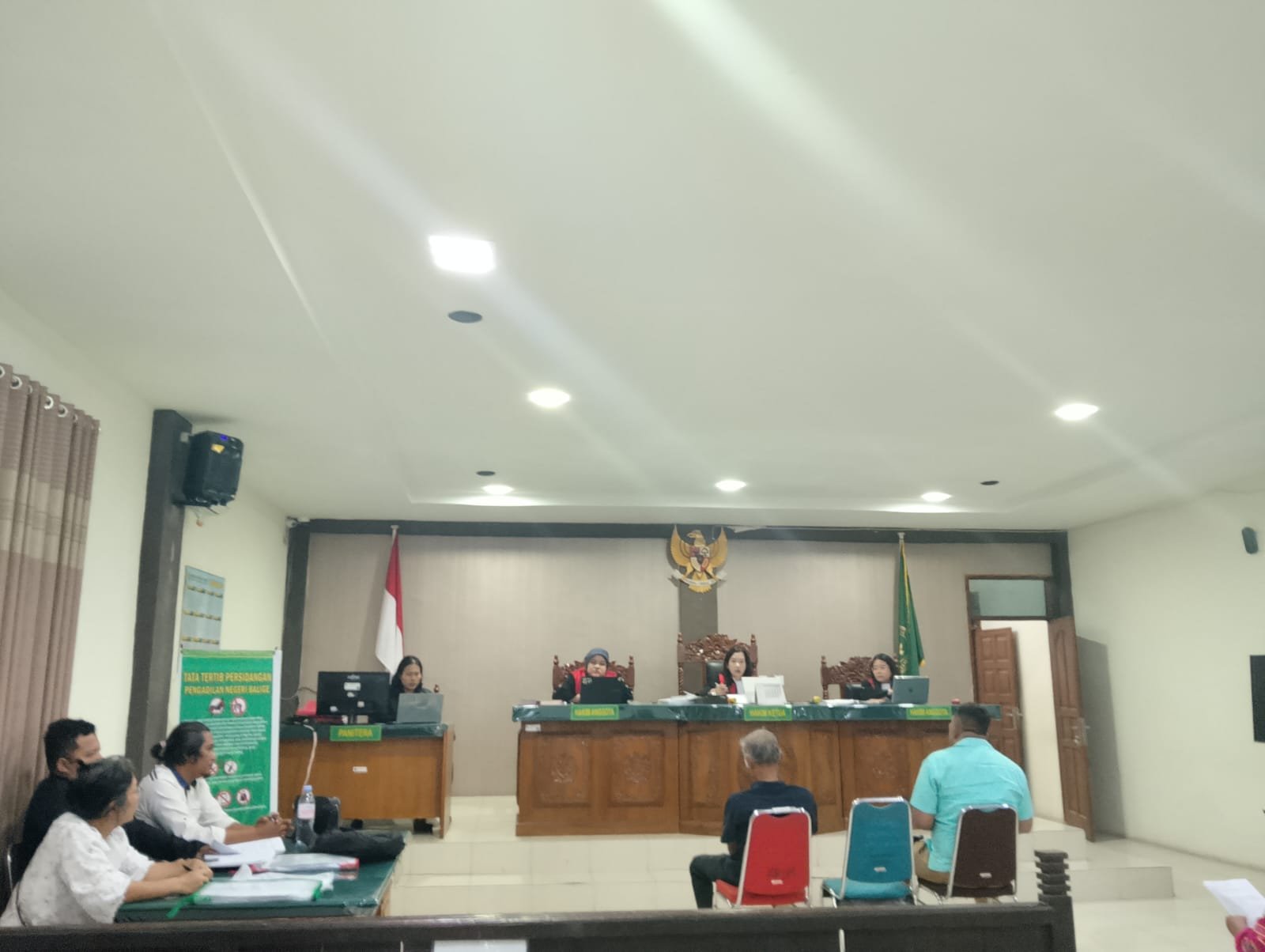
BALIGE – The Balige District Court resumed hearings on Wednesday, June 17, 2026, in an alleged unlawful act (PMH) lawsuit registered under Case Number 1/Pdt.G/2026/PN Blg. The latest session focused on witness examinations presented by the defendants in a dispute over ownership of a house measuring approximately 9 x 12 meters located on Jalan Lingkar Tuk-Tuk Siadong, Simanindo District, Samosir Regency.
The road was previously known to local residents as Jalan Raya Tuk-Tuk Siadong. The case centers on competing claims regarding possession and ownership of the property, which has become the subject of ongoing legal proceedings before the court.
Defense Presents Two Witnesses
During the hearing, the defense called two witnesses, Jhonpiter Ambarita and Rudianto Ambarita, both of whom provided testimony regarding the history of the house’s construction and the occupancy status of the disputed property.
Jhonpiter testified that, based on information he received from his parents, the house was built by Bismar Ambarita around 1993 or 1994. He further stated that Rolly Ambarita occupied the property between approximately 1996 and 1998.
However, when questioned by the plaintiff’s legal counsel about how the defendant initially entered and took control of the house, Jhonpiter admitted that he did not know the exact circumstances.
To clarify his testimony, Jhonpiter explained that he lived in Ambarita until 1998 before moving to Jakarta to pursue further education. He later returned and settled in Ambarita in 2012.
Connection to Previous Court Case
Jhonpiter also confirmed that the land currently under dispute is the same property involved in an earlier legal dispute known as Case Number 28 between Lamhot and others against Jonter.
According to his testimony, he served as a witness for the plaintiffs in that earlier case, who are also among the parties involved in the current litigation.
He explained that the plaintiff, defendant, and co-defendant in the present case were previously aligned as plaintiffs in Case Number 28. At that time, they supported the individual who is now a defendant in order to prevail against the biological brother of the parties currently engaged in the dispute.
Regarding family inheritance assets discussed in the previous case, Jhonpiter testified that Marroan Guesthouse and several other properties were part of the estate left by Bismar Ambarita. He stated that, based on a notarized will prepared by the parties’ mother, each heir had already received a designated share of the inheritance.
However, he emphasized that the house now under dispute, along with another building once occupied by the parties’ late sibling, was not included in the notarized will.
When asked about a major customary gathering that reportedly took place in Sosor Ambarita in 1997, Jhonpiter stated that he had no knowledge of the event because he was not present at the location at that time.
Second Witness Describes Construction Process
The second witness, Rudianto Ambarita, provided testimony regarding the construction of the disputed house and family-related events that occurred in 1997.
Before the panel of judges, Rudianto stated that the house was indeed built by Bismar Ambarita and that he personally assisted in the construction work as a labor assistant.
According to Rudianto, Clara Ambarita was not involved in the construction process because she was studying in Medan at the time.
Rudianto also testified that the defendant attended a family gathering held in 1997. Initially, he described the event as a tardidi ceremony, a traditional child baptism or ceremonial bathing.
However, when asked to clarify his statement by the plaintiff’s legal counsel, Rudianto briefly indicated that the term had been mentioned by the defense attorney, while looking toward the defense table.
The remark immediately triggered reactions from individuals present in the courtroom, resulting in a brief disturbance during the hearing.
Judges Call for Order in the Courtroom
The presiding judge quickly intervened, instructing the witness to provide consistent testimony and avoid changing his statements. The court also reminded all parties to remain calm and maintain order throughout the proceedings.
Afterward, Rudianto reaffirmed that the 1997 gathering was indeed a tardidi ceremony and a traditional cuci papan celebration for the plaintiff’s first child.
Significantly, he testified that there had never been any discussion, agreement, transfer, or grant of the disputed house to Rolly Ambarita during the customary event, either verbally or in writing.
Questions Remain Over Occupancy of the Property
Rudianto further testified that the first person to occupy the disputed house was the plaintiff.
According to him, the plaintiff resided there because the parties’ late parents instructed the plaintiff to live in the property. However, he acknowledged that he did not know when the defendant began occupying the house or how control over the property was eventually transferred.
He also stated that he did not know the exact amount of money exchanged during a traditional batu demban ceremony, although he recalled that the customary reciprocal contribution at the time was approximately Rp5,000.
Additionally, he testified that the local village head and members of the plaintiff’s in-law family attended the customary event.
Objections Raised During Testimony
Several statements made by both witnesses prompted objections and rebuttals from the plaintiff’s legal team and the co-defendant.
They argued that certain portions of the testimony did not accurately reflect events that occurred on the ground. Nevertheless, the presiding judge instructed all parties to reserve their objections for the final conclusion stage of the trial.
The panel recorded all witness statements, along with the objections raised by the parties, as part of the evidentiary process.
Trial to Continue Next Week
The hearing concluded with the court postponing further proceedings until Wednesday, June 24, 2026, when additional witnesses from the defense side are expected to testify.
Legal observers note that witness testimony regarding the property’s construction history, occupancy timeline, and inheritance status could play a significant role in helping the court determine ownership and possession rights over the disputed house.
As the case progresses, the Balige District Court is expected to continue examining documentary evidence, witness testimony, and arguments from all parties before reaching a final decision.
