

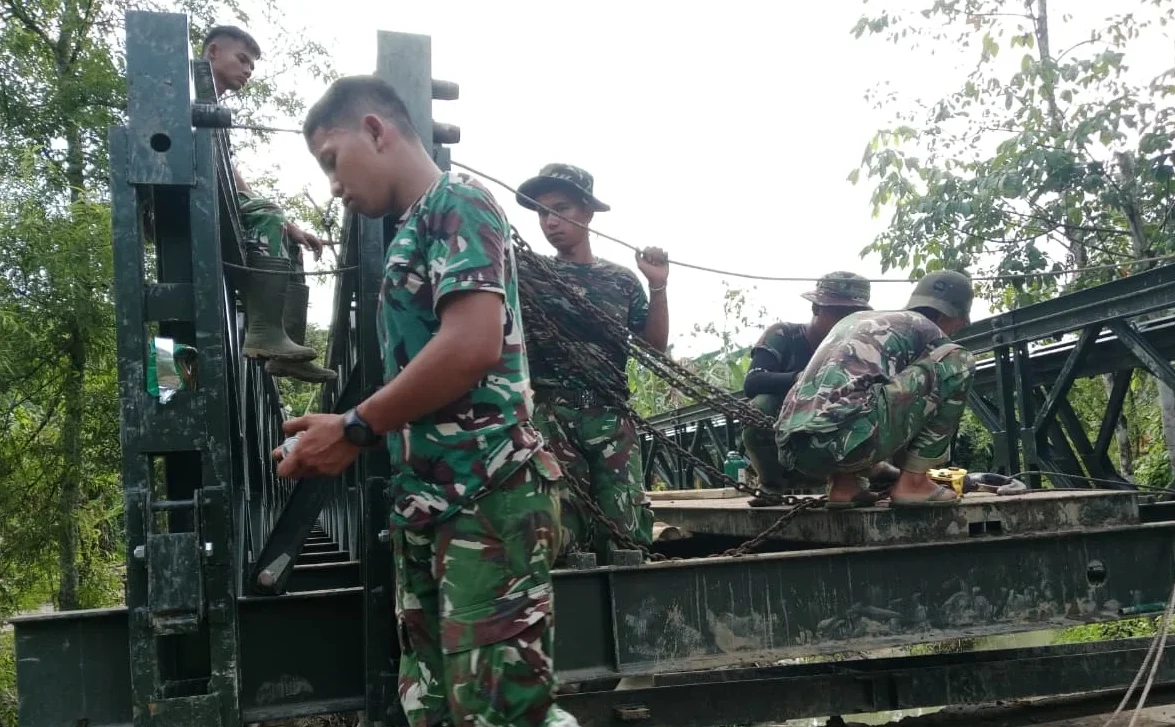
HALOSUMUT.COM – The Indonesian Army (TNI AD) is close to achieving another major success in its community outreach efforts. Under the framework of the Bakti TNI AD community development program, the construction of the vital modular bridge over the Fauro Faete River has officially entered its final assembly stage.
This targeted infrastructure project is specifically designed to restore regional logistics distribution and reconnect isolated rural areas, proving the army’s tactical capability to quickly deploy engineering solutions to regions suffering from severe infrastructure damage.
The Fauro Faete River modular bridge project was initiated following severe environmental challenges that cut off local land transport links. Military engineers from the Army Construction Battalion (Yenizipur), working alongside local territorial units (Kodim), have been working around the clock to install the heavy-steel modular structures.
Unlike traditional concrete bridges that require months to dry and set, this modular design allows for rapid assembly while maintaining high structural strength capable of supporting medium-weight commercial and passenger vehicles.
Field commanders reported that despite unpredictable weather conditions and difficult geographical terrain, the physical progress of the bridge has crossed the 90% mark. Current operations are strictly focused on securing the structural anchor points, strengthening the approach roads on both riverbanks, and conducting rigorous load-bearing safety tests.
The swift progress of this project is highly credited to the seamless cooperation between military personnel, local government public works departments, and native volunteers who assisted in clearing the construction zone.
The completion of the Fauro Faete modular bridge brings massive legal, social, and economic structural impacts to the surrounding sub-districts.
Before this intervention, the broken river crossing forced hundreds of families into dangerous situations, with school children and farmers risking their safety by crossing the rushing river currents manually or using expensive, unstable makeshift rafts.
By creating a safe, permanent crossing, the TNI AD directly restores basic human rights regarding safe public mobility and unhindered access to formal education and emergency healthcare facilities.
From an economic perspective, the bridge acts as a vital lifeline for local agriculture. The previous transport bottleneck caused local commodity prices to drop significantly due to high distribution costs and delayed transit times.
Once the modular bridge is fully operational, local farmers can immediately resume direct supply routes to major sub-district markets.
This will eliminate predatory middlemen, significantly reduce logistics overhead for basic goods, and stimulate fresh economic growth across the region’s grassroots economy.
As an immediate solution to guarantee public safety before the official opening ceremony, the local territorial military command (Babinsa) alongside village leaders will establish a temporary weight-monitoring post.
This watch group will ensure that heavy-duty trucks exceeding the bridge’s maximum tonnage capacity do not cross the modular structure during its initial operational phase.
For a long-term structural solution, the regional government must allocate regional budget (APBD) funds to continuously maintain the bridge and build permanent concrete retainers on the riverbanks to prevent soil erosion during the annual rainy season.
Furthermore, expanding the Bakti TNI AD program into a permanent civil-military partnership blueprint remains the ultimate tool for local governments to accelerate infrastructure development in remote, disaster-prone border zones.
This synergy ensures that rural public assets remain highly resilient, secure, and fully capable of driving regional prosperity for decades to come.

1 Comment
Pingback: KWI Under Umar Hayat Holds High-Level Audience with Polrestabes Surabaya to Fortify Community Security - Halo Sumut