

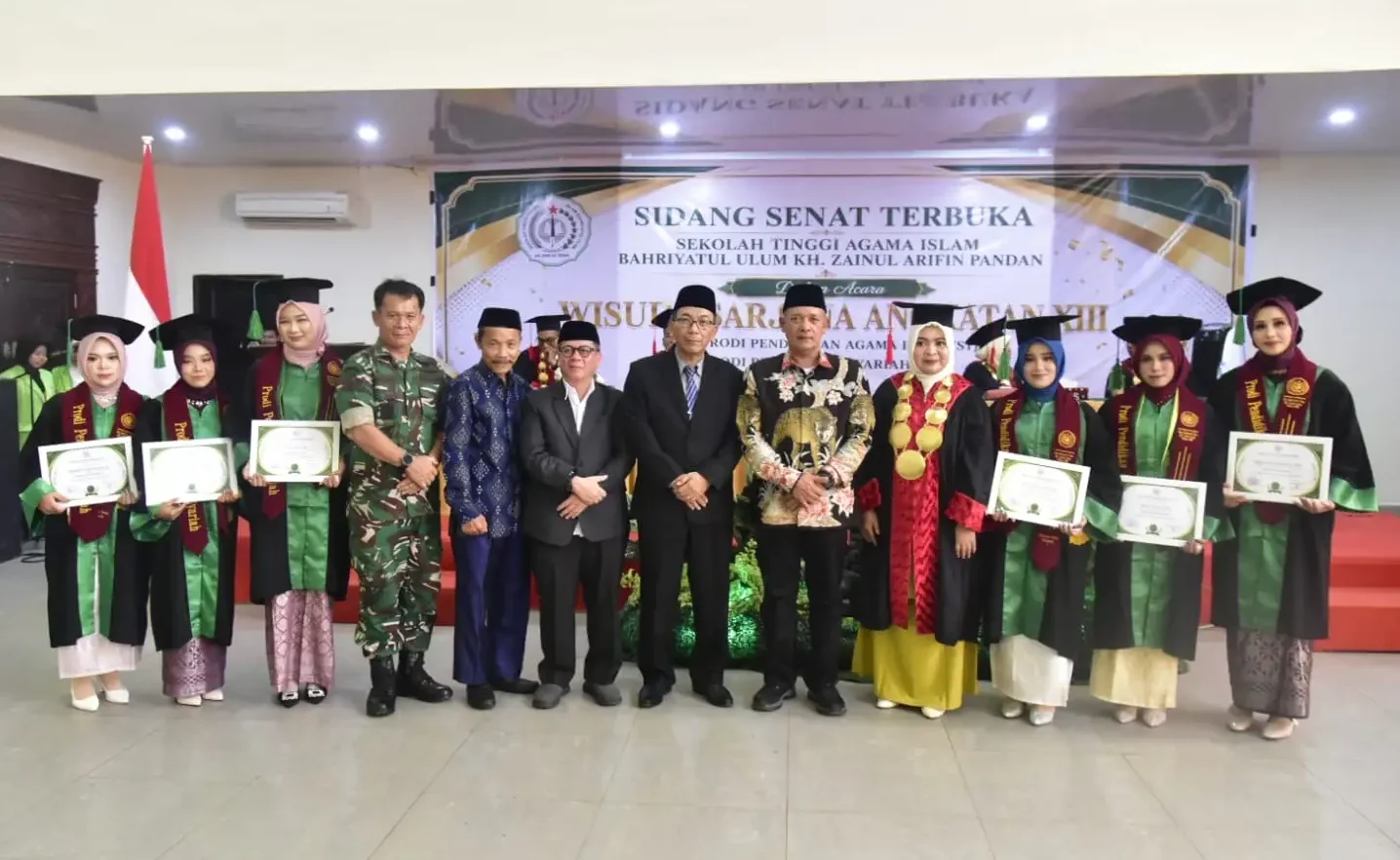
PANDAN, HALOSUMUT.COM – The Islamic higher education landscape in Central Tapanuli (Tapteng) celebrated a significant milestone as Sekolah Tinggi Agama Islam (STAI) Bahriyatul Ulum Pandan officially successfully held its 13th graduation ceremony.
The grand academic convocation, which took place in Pandan, marked the official transition of dozens of Islamic education and sharia graduates from higher education into the professional workforce.
Through this landmark event, the campus firmly re-emphasized its long-term strategic commitment to acting as a premier incubator for producing a highly competitive, morally sound, and intellectually capable Islamic generation in North Sumatra.
The 13th graduation ceremony was attended by the campus senate, prominent local government officials, religious leaders, and the proud families of the graduates.
The leadership of STAI Bahriyatul Ulum Pandan explained that the newly minted graduates have undergone years of rigorous, integrated curricula that beautifully combine standard academic excellence with deep Islamic values.
The majority of the graduating class completed flagship programs within the Tarbiyah (Islamic Education) and Sharia faculties, equipping them with both theoretical knowledge and practical teaching skills.
Furthermore, the campus management highlighted that this specific batch of graduates holds a unique value, as their study period coincided with the institution’s recent aggressive push toward modernizing its digital learning infrastructure.
Over the past few years, STAI Bahriyatul Ulum Pandan has steadily upgraded its learning facilities, integrated online research journals, and expanded community service (Kuliah Kerja Nyata) programs.
These structural improvements ensure that the graduates are not only well-versed in classical Islamic jurisprudence but are also highly proficient in modern educational technology.
The continuous graduation of qualified scholars from STAI Bahriyatul Ulum Pandan brings a massive, positive structural impact to the social fabric of Central Tapanuli and its surrounding districts.
By consistently deploying new educators into the field, the campus acts as a vital pillar in addressing the regional shortage of qualified Islamic studies teachers in both public schools and private madrasahs.
These young scholars are strategically positioned to elevate the quality of religious literacy and characters of the younger generation across the province.
From a broader developmental perspective, the academic stability of this institution helps counter the urbanization trend of local talent.
Historically, many high-achieving high school graduates from the western coast of North Sumatra felt forced to migrate to larger metropolitan areas like Medan or Banda Aceh to access quality Islamic higher education.
By maintaining high institutional standards locally in Pandan, STAI Bahriyatul Ulum actively keeps intellectual talent within the region, driving local economic growth and stimulating progressive religious discourse directly at the grassroots level.
As a practical solution to ensure that these newly graduated scholars do not face career stagnation in an increasingly tight job market, the campus infrastructure has set up a dedicated career development pipeline.
The institutional leadership strongly urges the alumni network to immediately utilize the campus’s career center, which forms direct partnerships with local educational foundations, Islamic financial institutions, and government offices.
Additionally, to thrive in the modern era, the campus recommends that graduates proactively combine their formal degrees with continuous digital skill acquisition.
Pursuing specialized certifications in digital journalism, online educational platforms, and creative content creation will allow these Islamic scholars to preach and teach effectively through modern digital mediums.
By systematically bridging the gap between traditional religious wisdom and modern marketplace demands, the alumni of STAI Bahriyatul Ulum Pandan can confidently position themselves as highly resilient leaders capable of guiding society toward a progressive, moral future.
