

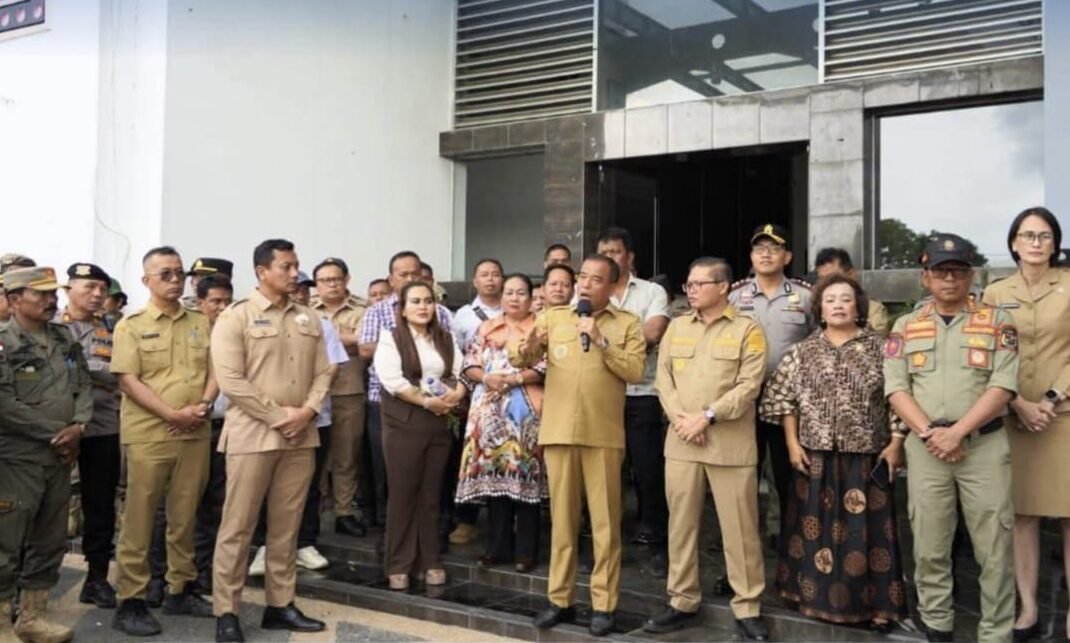
KABANJAHE, HALOSUMUT.COM – The Regent of Karo, Brigadier General Pol (Ret.) Dr. dr. Antonius Ginting, SP.OG, M.Kes, accompanied by Vice Regent Komando Tarigan, SP, officially received an audience from the Karo Regency Flower Farmers Forum. The peaceful dialog took place at the Rakoetta Brahmana Hall, Karo Regent’s Office, on Monday, July 20, 2026.
During the meeting, local farmers voiced their concerns regarding the increasingly difficult conditions facing the flower cultivation business over the past few years. They highlighted a significant decline in income, a shrinking number of active flower farmers, and a narrowing market space due to stiff competition from a large-scale flower enterprise, PT. Tamora Stekindo, which actively markets its products locally.
The forum strongly urged the local government to immediately draft regulations to protect local farmers, supervise major corporate operations, and foster fair business competition. Additionally, the farmers requested to be actively involved in policy-making and called for tangible government support to enhance their competitiveness through coaching, technological adoption, and expanded market access.
Responding to these demands, the Regent of Karo explained the legal boundaries of the administration.
“PT. Tamora Stekindo possesses a valid Business Identification Number (NIB) and licensing in accordance with statutory regulations. Therefore, the local government has no legal basis to halt the company’s operations or marketing activities as long as no violations are found. If violations are discovered in the future, decisive action will be taken according to existing authorities,” Dr. Antonius Ginting stated.
Furthermore, the Regent emphasized the government’s balanced commitment to both investment and local livelihoods.
“The government will review the proposed regulatory framework together with the Regional House of Representatives (DPRD), thoroughly considering legal aspects, investment protection, farmers’ interests, labor, and the overall economic impact. We have instructed the Department of Agriculture and the Department of Industry and Trade to tighten supervision and verify flower production and distribution data in the field,” he added.
Commitment to Floriculture Empowerment
To bolster the local agricultural ecosystem, the Karo Regency Government has committed to strengthening guidance for farmers through targeted training, technology transfer, cultivation assistance, and the development of modern screen houses.
As an immediate marketing boost, the government pledged to prioritize the use of flowers from local farmers during the upcoming Karo Regency Flower and Fruit Festival. The administration also encourages farmers to establish formal institutions or cooperatives to facilitate easier access to financing, professional mentoring, and broader marketing networks. Representatives from the Flower Farmers Forum will be included in follow-up discussions regarding regulations and the strategic development of the floriculture sector.
Closing the meeting, the Regent of Karo reiterated his administration’s dedication to the community.
“The Karo Regency Government remains firmly supportive of farmers as a strategic sector of the region. All aspirations presented today will be followed up through cross-departmental coordination with the DPRD to find the right policy steps, while maintaining a precise balance between local farmer protection and investment sustainability in Karo Regency.”
The high-level audience was also attended by key regional figures, including Karo Police Chief AKBP Pebriandi Haloho, SH, S.I.K., M.Si., Chairperson of the Karo DPRD Iriani Br Tarigan, Regional Secretary of Karo Regency Dr. Gelora Kurnia Putra Ginting, S.STP, MM, representatives of the Karo DPRD, heads of relevant regional government agencies (OPD), and members of the Flower Farmers Forum community.
Karo Regency, nestled in the fertile highlands of North Sumatra, has long been recognized as one of the primary agricultural and floriculture hubs in western Indonesia. The cool climate and volcanic soil surrounding Mount Sinabung create ideal conditions for cultivating high-value ornamental plants, including chrysanthemums, roses, and marigolds. For decades, traditional flower farming has served as a vital economic backbone for thousands of rural households across districts like Berastagi and Kabanjahe.
However, the rapid modernization of the agricultural supply chain has introduced unprecedented challenges for smallholders. The entry of well-capitalized corporations brings highly efficient cultivation technologies, automated greenhouse systems, and sophisticated logistics networks that traditional farmers struggle to match. This dynamic frequently creates a market imbalance, where local small-scale farmers face downward pressure on prices due to the high volume of corporate yields entering the regional market.
Economic analysts note that the local government’s move to bridge the gap between corporate investors and local growers through cooperatives is crucial. By forming clusters or corporate-like legal entities, local flower farmers can pool resources, standardize quality, and gain collective bargaining power. This strategy, combined with strict zoning or market distribution policies, is seen as a viable path to ensuring that corporate investments stimulate the local economy rather than marginalizing traditional agrarian communities.
