

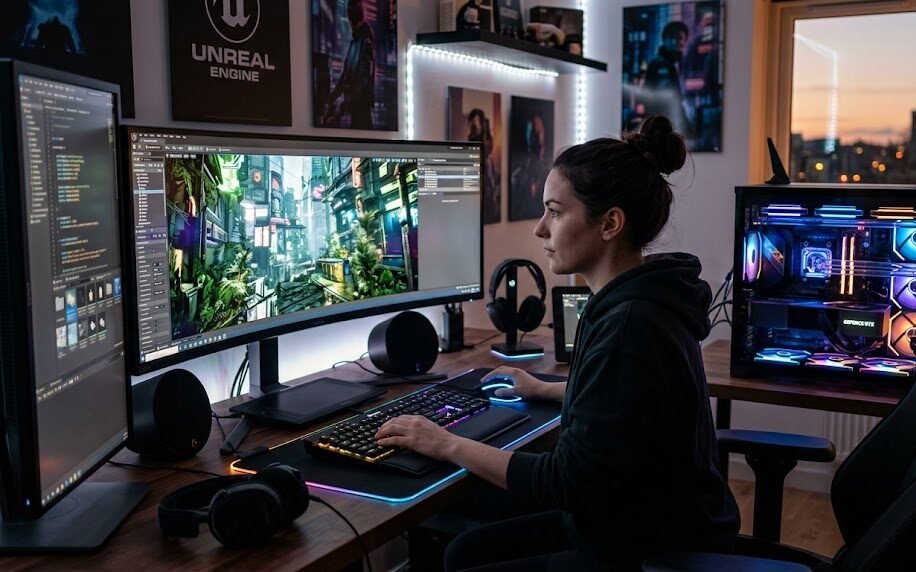
High-end gaming PCs are no longer built exclusively for gaming enthusiasts. Equipped with cutting-edge processors, powerful graphics cards, and AI-enhanced computing capabilities, these systems are becoming essential tools for real-time 3D content creation across industries ranging from game development to architecture, film production, and virtual reality.
As creative software continues shifting toward real-time rendering, professionals increasingly rely on gaming-class hardware to accelerate complex workflows. Advanced GPUs and multi-core CPUs allow artists, animators, and designers to visualize detailed projects instantly, reducing production time while improving creative flexibility.
The growing convergence between gaming technology and professional content creation is reshaping workstation expectations, making high-performance gaming PCs a practical solution for demanding creative workloads.
Modern graphics processing units (GPUs) have become the backbone of real-time 3D production. Unlike traditional rendering methods that may require hours to process complex scenes, today’s high-end gaming GPUs allow creators to preview lighting, textures, shadows, and visual effects almost instantly.
This capability enables artists to make immediate design adjustments without interrupting their workflow, significantly improving productivity in industries that depend on high-quality visual content.
Real-time rendering has become particularly valuable for game developers, visual effects studios, architects, and industrial designers who require rapid design iteration.
AI Acceleration Enhances Creative Productivity
Artificial intelligence is playing an increasingly important role in digital content creation. High-end gaming PCs now integrate AI acceleration technologies that support intelligent upscaling, automated scene optimization, noise reduction, animation assistance, and image generation.
These AI-powered features reduce repetitive tasks, allowing creators to focus on artistic decisions rather than technical processes.
As AI tools become standard across professional creative software, gaming-class hardware provides the computational power necessary to maintain responsive performance during intensive production workloads.
Beyond Gaming: A New Generation of Creative Workstations
The distinction between gaming PCs and professional workstations continues to narrow.
Many content creators now choose premium gaming systems because they deliver exceptional graphics performance, fast memory, high-speed storage, and advanced cooling solutions at competitive price points. These systems are capable of handling demanding applications for video editing, 3D animation, CAD design, virtual production, and simulation.
For independent creators and small production studios, gaming PCs provide an attractive balance between performance, versatility, and long-term upgradeability.
Real-Time Collaboration Gains Momentum
Cloud-based production pipelines and collaborative design platforms are driving demand for hardware capable of processing increasingly complex projects in real time.
High-end gaming PCs support smooth interaction with large 3D environments, enabling multiple team members to review, modify, and present digital assets with minimal delay. This capability has become particularly valuable for remote teams working on interactive experiences, digital twins, and virtual production environments.
Faster rendering and responsive editing also help businesses shorten production cycles and improve project delivery timelines.
Next-Generation Hardware Shapes the Future of Digital Creation
The continued advancement of CPUs, GPUs, AI processors, and high-bandwidth memory is redefining expectations for creative computing.
Manufacturers are introducing hardware specifically optimized for real-time graphics, machine learning, and immersive technologies such as augmented reality (AR), virtual reality (VR), and mixed reality (MR). These innovations are enabling creators to develop increasingly realistic digital experiences without relying solely on expensive enterprise workstations.
As creative industries continue embracing real-time production techniques, high-end gaming PCs are expected to remain at the forefront of digital innovation, providing professionals with the performance needed to transform ambitious ideas into interactive visual experiences.
The rapid growth of game engines used outside the gaming industry has significantly increased demand for powerful consumer hardware. Real-time visualization is now widely adopted in architecture, automotive design, engineering, healthcare simulation, and film production, where instant rendering improves collaboration and accelerates project development.
Advancements in PCIe Gen5 storage, DDR5 memory, AI-assisted rendering, and ray tracing technology are further enhancing creative workflows. These innovations reduce loading times, accelerate asset processing, and enable creators to work with increasingly detailed 3D environments while maintaining smooth system responsiveness.
Industry analysts expect the convergence of gaming hardware and professional creative tools to continue over the coming years. As artificial intelligence, immersive media, and real-time graphics become standard across digital production, high-end gaming PCs will play an increasingly important role in supporting creators, developers, designers, and visual storytellers worldwide.
