

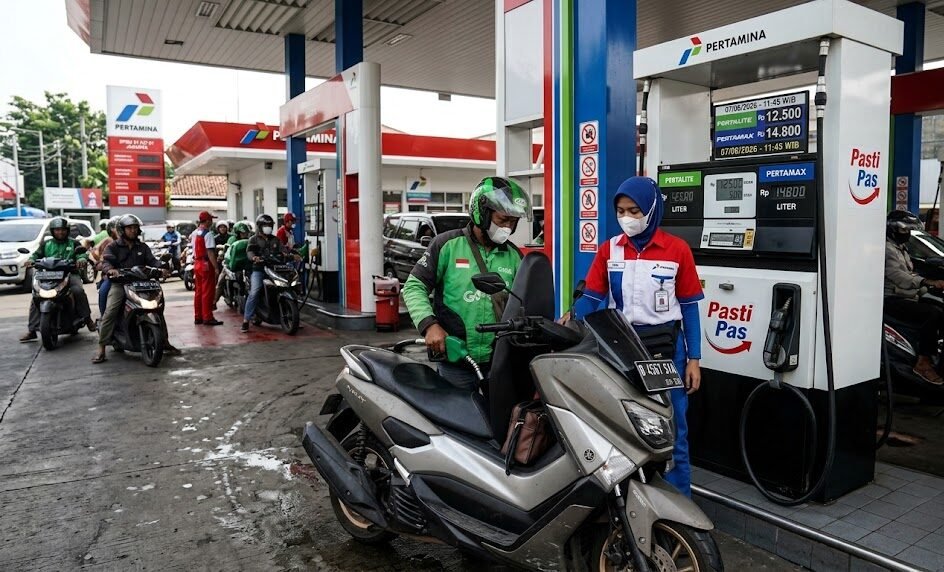
JAKARTA, HALOSUMUT.COM – Fuel retail operators across Indonesia, including the state-owned energy conglomerate PT Pertamina (Persero) and major private competitors such as Shell, Vivo, and BP AKR, have officially implemented nationwide fuel price adjustments effective June 7, 2026.
This sudden fiscal recalibration modifies the retail price of non-subsidized fuel variants across all gas stations (SPBU) from Sabang to Merauke, forcing corporate logistics sectors and daily commuters to adjust their operational budgets in accordance with the new price ceilings.
The June 2026 corporate adjustments reveal a highly calculated shift across specific fuel octane ratings. For Pertamina stations in the Java-Bali corporate zone, the price of Pertamax (RON 92) has been adjusted to navigate regional market dynamics, while premium variants like Pertamax Turbo and the Pertamina Dex series have also seen synchronized rate variations.
Meanwhile, subsidized fuel types, namely Pertalite (RON 90) and Solar (Subsidized Diesel), remain heavily capped by government intervention to shield low-income demographics from immediate market shocks.
From the private sector perspective, operators like Shell Indonesia and Vivo Energy have immediately mirrored the government-backed pricing adjustments to maintain corporate competitiveness. Shell has rolled out updated pricing structures for its signature Super, V-Power, and V-Power Diesel lines.
Concurrently, Vivo has realigned the retail costs of its Revvo 90, 92, and 95 products, ensuring that the competitive gap between state-owned and multinational refueling infrastructures remains highly dynamic on the ground.
This systematic price adjustment stems directly from the ongoing volatility of global crude oil benchmarks, specifically Brent and West Texas Intermediate (WTI), combined with fluctuations in the Rupiah exchange rate against the US Dollar.
Because Indonesia operates as a net oil importer, any significant geopolitical friction in energy-producing regions immediately stresses the state budget (APBN). Non-subsidized fuel prices must therefore undergo periodic corporate corrections to prevent severe financial deficits within Pertamina’s operational balance sheets.
The domestic socio-economic impact of this price shift is expected to ripple across various economic layers. On a micro-level, even minor price changes in non-subsidized fuels directly increase the operational overhead of mid-to-high income commuters and private transport services.
On a macro-level, logistics companies managing national supply chains may face subtle profit margin squeezes, which could gradually lead to minor price adjustments for consumer goods if international energy markets remain unstable throughout the second quarter of 2026.
As a practical solution to mitigate the financial strain caused by fluctuating energy prices, corporate fleet managers and everyday commuters are strongly urged to maximize operational fuel efficiency. Utilizing digital route-optimization software and conducting routine vehicle maintenance can decrease overall fuel consumption by up to 15%.
Furthermore, the government continues to push for a structural, long-term solution by accelerating the national transition toward the Electric Vehicle (EV) ecosystem and expanding public transport networks across major metropolitan zones, including North Sumatra.
For vehicle owners still reliant on combustion engines, utilizing official fuel tracking applications—such as the MyPertamina platform—remains the most effective tool to locate verified pricing structures, manage corporate refueling quotas, and claim digital loyalty rewards to offset rising transport expenditures.
