

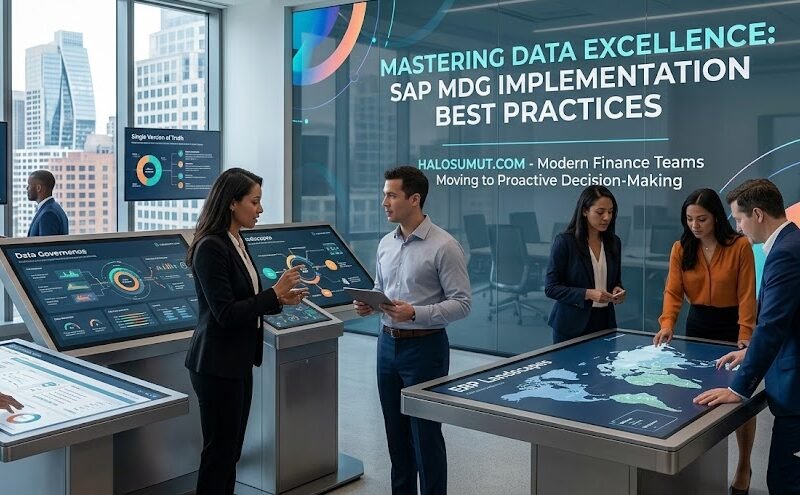
HALOSUMUT.COM – In today’s hyper-digitized and fast-paced business environment, modern finance leaders are rapidly progressing far beyond traditional, reactive reporting frameworks.
Instead, the industry is seeing a major shift toward proactive, data-driven decision-making, where master data quality has firmly established itself as a fundamental strategic advantage.
For enterprise organizations utilizing complex ERP landscapes, implementing SAP Master Data Governance (SAP MDG) is no longer just a technical IT project—it is a critical business transformation that ensures financial compliance, reporting accuracy, and operational agility.
To achieve a flawless deployment, organizations must adhere to clear implementation best practices that bridge the gap between finance and technology.
Establishing a robust data governance council, defining precise data validation workflows, and standardizing financial dimensions across global entities are paramount. Furthermore, finance teams must champion automated data quality checks at the point of entry rather than attempting to clean data retroactively.
By embedding data integrity directly into everyday workflows, modern finance departments can successfully mitigate reporting risks, streamline the month-end closing process, and build a “single version of truth” that drives precise corporate strategy.
As enterprise architecture becomes increasingly decentralized through multi-cloud environments, the demand for centralized data governance tools has skyrocketed. Industry analysts report that companies with unstandardized vendor, customer, or general ledger master data face up to a 30% increase in operational friction during large-scale digital transformations.
The integration of SAP MDG acts as a crucial safeguard, eliminating costly duplicate entries and ensuring that regulatory reporting—such as ESG compliance and international tax auditing—remains seamless and fully traceable.
Moreover, the latest advancements in agentic artificial intelligence and machine learning are revolutionizing how master data governance operates. Modern SAP MDG frameworks are now integrating AI-driven predictive analytics that can automatically detect anomalies, suggest proper asset categorizations, and route approval workflows dynamically based on risk profiles.
This evolution allows finance professionals to shift their focus away from tedious manual data validation tasks and dedicate their valuable time to strategic financial planning and high-level market analysis.
As organizations continuously map their digital transformation roadmaps for the upcoming fiscal years, the alignment between clean data governance and corporate success is undeniable.
Embracing a comprehensive data strategy today ensures that enterprise finance teams are fully equipped to navigate future market volatilities. For multinational corporations looking to scale efficiently, a well-executed data governance framework remains the ultimate backbone of modern financial resilience.
