

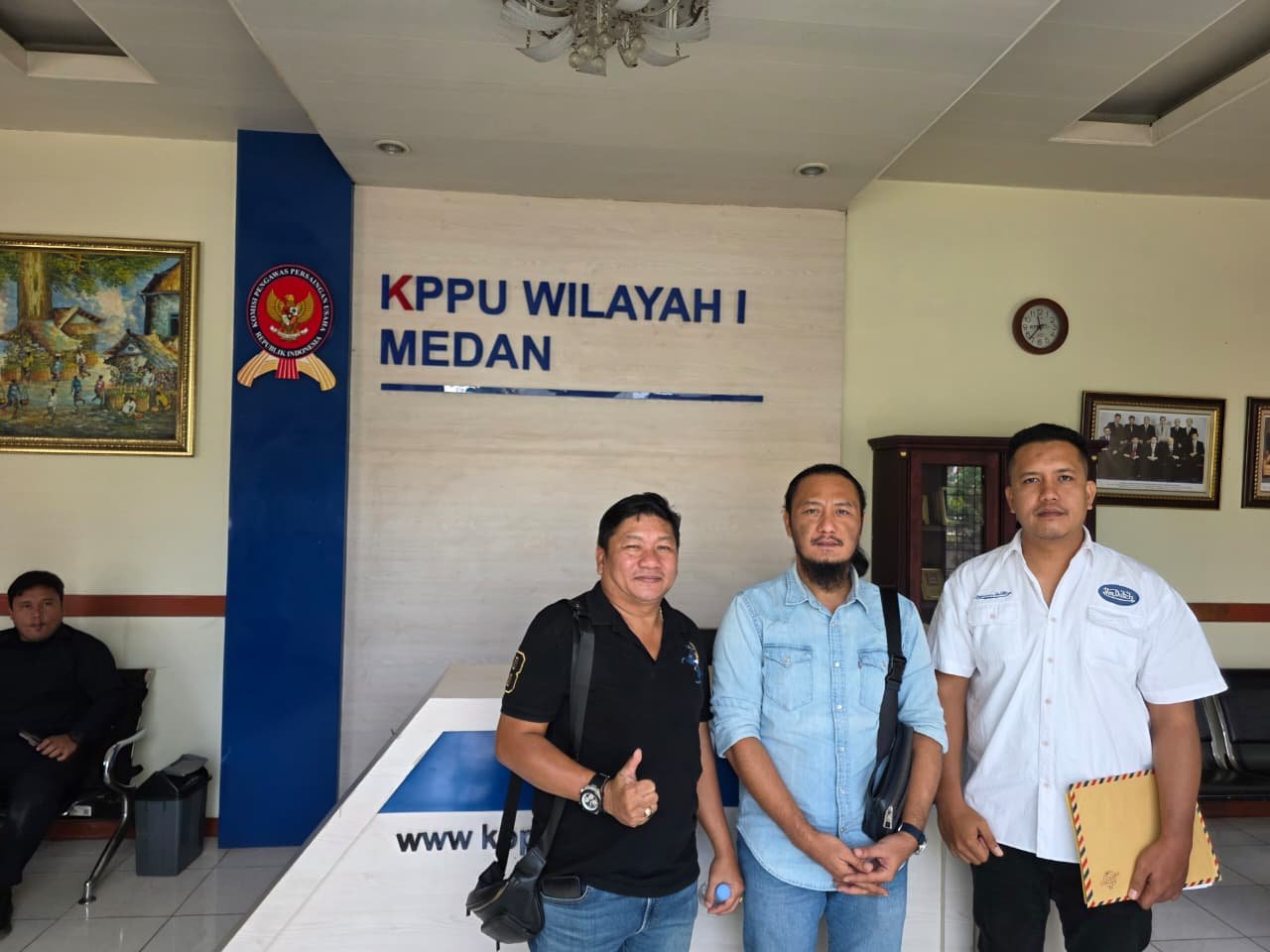
MEDAN, July 2, 2026 – The latest partnership transition policy implemented by PT Telekomunikasi Selular (Telkomsel) through its Next Generation Partner Program (NGPP) Transition Household 2026 has officially sparked a major legal backlash. A number of local partner companies are crying foul, claiming massive losses after their Partnership Agreements (PKS) were abruptly cut off following the tech giant’s newest partner selection process.
One of the affected local companies hailing from Stabat, Langkat Regency, namely CV Fadin—backed by CV Eka Putra Mandiri and CV Putra Pertama Perkasa as formal witnesses—has officially taken the fight to the authorities. They filed a formal report regarding alleged anti-competitive business practices to the Regional Office I of the Business Competition Supervisory Commission (KPPU) in Medan on Wednesday (July 1, 2026).
Director of CV Fadin, Arbi Hasibuan, firmly stated that the report was filed because his party strongly suspects elements of tying agreements, abuse of dominant position, and deeply discriminatory treatment aimed directly at regional local partners during the execution of the NGPP Transition Household 2026 program.
According to Arbi, Telkomsel rolled out a controversial new scheme by merging the home internet service marketing business line (Household) with the prepaid credit distributor or Business Mobile line. This newly integrated policy, he explained, strictly forces potential partners to possess a massively inflated capital capacity, far exceeding the actual financial requirements previously needed to run a standard home internet marketing operations.
“We were forced to follow this combined business scheme. The financial evaluation aspect holds a massive weight of 40 percent, requiring billions of rupiah in capital turnover every single month. In reality, the characteristics of the prepaid credit distribution business are vastly different from home internet marketing, which relies heavily on localized territorial mastery,” Arbi stated during a press briefing on Thursday (July 2, 2026).
As a direct result of this high-stakes financial evaluation scheme, CV Fadin was declared to have failed the selection process, which was announced back on June 26, 2026. On the flip side, the complainant revealed that Telkomsel has instead appointed several major, large-scale corporations as Strategic Business Partners (SBP), granting them newly allocated operational territories.
The complainant strongly believes this policy completely disregards the long-standing track record of local enterprises that have served as Telkomsel’s official partners in marketing IndiHome for nearly a decade. Arbi emphasized that his company has been smoothly operating for around ten years, fully backed by dedicated human resources, strong local infrastructure, and an impressive average Key Performance Indicator (KPI) score well above 84 percent.
“We have the experience, the human resources, the infrastructure, and a stellar performance record. Yet, all of that was completely tossed out the window simply because we lost on the massive capital instrument scale. We view this exact condition as a blatant form of discrimination against regional business players,” he added.
In the formal report submitted to KPPU Kanwil I Medan, the complainant outlined several alleged violations of existing laws and statutory regulations, including:
-
Article 15 Paragraph (2) of Law Number 5 Year 1999 regarding the strict prohibition of tying agreements or contracts that tie the purchase of one product to another forced product;
-
Article 19 and Article 25 of Law Number 5 Year 1999 concerning the alleged abuse of dominant position and discriminatory practices in business competition; and
-
Article 35 of Law Number 20 Year 2008 concerning Micro, Small, and Medium Enterprises (MSMEs), which strictly bars large-scale enterprises from dominating or exploiting smaller business entities to their detriment.
Beyond demanding that the KPPU launch a thorough investigation and examination into the entire NGPP Transition Household 2026 selection process, the complainant has also requested the immediate issuance of a provisional status quo determination. This legal measure aims to freeze and delay the transition of operational territories—particularly in the Binjai and Langkat regions—until the entire legal probe is wrapped up and a legally binding, final verdict is officially reached.
The complainant highly hopes that this strategic legal move will put a halt to further devastating financial losses for local partner companies who have spent years building a loyal partnership with Telkomsel on the ground.
Up until this report went live, KPPU Kanwil I Medan is reportedly still conducting preliminary verifications on the official complaint, alongside analyzing the pile of supporting documents and evidence handed over by the complainant.
Meanwhile, Telkomsel has not yet released an official response regarding the filed report. The editorial team is continually attempting to secure an official confirmation from Telkomsel’s management to ensure their right of reply is fully represented, in accordance with the provisions of Law Number 40 Year 1999 concerning the Press.
The corporate restructuring under Telkomsel’s Next Generation Partner Program (NGPP) marks a major paradigm shift in how telecom giants manage their distribution networks. By shifting toward an integrated business model that demands immense capital, industry experts point out that local enterprises often bear the brunt of globalization and corporate consolidation. The blending of completely different service lines—high-volume credit distribution and territory-based home internet acquisition—implicitly creates a high barrier to entry that favors national-scale conglomerates over regional players who built the groundwork.
This case adds to a growing list of anti-trust scrutiny surrounding major digital and telecommunication mergers in Indonesia over recent years. As home internet and digital services expand across North Sumatra, local partners have served as vital engines for local employment and regional digital penetration. The abrupt disqualification of local players who possess high KPI scores raises serious socio-economic concerns, particularly regarding the potential wave of layoffs among regional staff who have managed these territories for nearly ten years.
Moving forward, the outcome of KPPU Kanwil I Medan’s investigation will serve as a crucial benchmark for partnership dynamics between national tech monopolies and provincial MSMEs. If the status quo is granted, it could temporarily reshape distribution strategies in Binjai and Langkat, setting a monumental precedent for fair business competition and corporate accountability across Indonesia’s telecom sector.
