

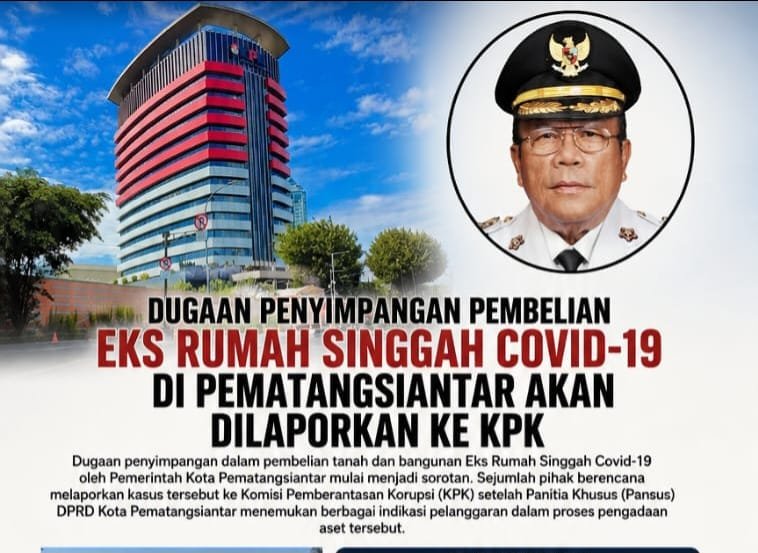
HALOSUMUT.COM, SIANTAR – Allegations of irregularities surrounding the purchase of land and buildings formerly used as a COVID-19 shelter by the Pematangsiantar City Government are drawing increasing public attention.
Several parties have announced plans to submit a formal complaint to Indonesia’s Corruption Eradication Commission (KPK) after a Special Committee (Pansus) of the Pematangsiantar City Regional House of Representatives (DPRD) identified multiple indications of potential violations during the procurement process.
According to complaint documents obtained by the media, the city government acquired the property located on Singamangaraja Street, Bukit Sofa Village, Siantar Sitalasari District, for approximately Rp14.53 billion. The acquisition was financed through the 2025 Regional Budget (APBD) and its revised allocation.
Special Committee Identifies Multiple Findings
In its investigation report and official recommendations, the DPRD Special Committee outlined at least 12 findings that it believes warrant further examination by law enforcement authorities.
Among its primary observations was the alleged absence of a Regional Government Asset Requirement Plan (RKBMD), a document that normally serves as the legal basis for government asset procurement.
The committee also concluded that the purchase may have proceeded without a comprehensive needs assessment, raising questions regarding the justification for the acquisition.
Procurement and Appraisal Process Under Scrutiny
The Special Committee further questioned the appointment process of the Public Appraisal Service Office (KJPP) responsible for valuing the property.
Based on testimony from the Head of Pematangsiantar’s Procurement Unit (UKPBJ), the procurement office reportedly was not involved in selecting the appraisal consultant.
Following consultations with the Indonesian Society of Appraisers (MAPPI), the committee also found that the appraisal report allegedly lacked several essential valuation components, including comparable market data, sources of market information, and detailed valuation analysis.
According to the committee, these omissions could affect the transparency and credibility of the appraisal process.
Questions Raised Over Property Valuation
The committee also questioned the reasonableness of the property’s assessed value.
Its report noted that one building allegedly lacking a valid Building Construction Permit (IMB) received a higher valuation than another structure that reportedly possessed complete legal documentation.
The discrepancy has become one of several issues highlighted in the committee’s recommendations for further investigation.
Land Status and Ownership Concerns
Beyond valuation issues, the committee identified potential concerns regarding the legal status of portions of the land.
Based on overlay documents obtained from the Pematangsiantar Land Office, part of the purchased property is suspected to be located within a river basin (Daerah Aliran Sungai/DAS).
Meanwhile, ownership records reportedly showed that as of February 13, 2026, the land remained registered under a Right to Build (HGB) certificate in the name of Jony Lee, despite payment having already been made using public funds. According to the committee, ownership had not yet been formally transferred to the Pematangsiantar City Government.
Inconsistencies and Missing Documents
The Special Committee also reported inconsistencies between statements provided by the former Head of the Regional Financial and Revenue Management Agency (BPKPD) and those of the property owner’s heirs concerning the negotiation process and transaction pricing.
During the investigation, the committee stated that several requested documents were not submitted by the city government, including Land and Building Tax (PBB) records, borrowing agreements, original building permits, and other supporting documents.
The absence of these documents, according to the committee, limited its ability to fully verify certain aspects of the transaction.
Estimated Financial Impact
Using estimates of the building’s age—believed to have been constructed around 2008—and referring to depreciation provisions contained in the Minister of Finance Regulation No. 72 of 2023, the committee estimated that the building may have been overvalued by approximately Rp6.18 billion.
Based on simulations and analysis of all findings, the committee suggested that potential state or regional financial losses could range from Rp6.18 billion to more than Rp10 billion.
However, the report emphasized that determining the exact amount of any financial loss would require an investigative audit conducted by the competent auditing authorities.
Complaint Planned for the KPK
According to the complaint letter being prepared, the reporting parties will request that the Corruption Eradication Commission (KPK) conduct a formal investigation into the alleged corruption related to the procurement process.
The complaint also asks investigators to examine all individuals who may have had knowledge of or involvement in the planning, appraisal, budgeting, payment, and ownership transfer stages of the acquisition.
Official Response Still Pending
As of the publication of this report, no official response had been received from the Pematangsiantar City Government or from individuals mentioned in the committee’s findings regarding the allegations presented.
The editorial team continues to seek confirmation from all relevant parties in accordance with the principles of balanced and fair reporting.
The case has attracted public attention because it concerns the use of regional government funds allocated through the municipal budget. Procurement of public assets is generally expected to follow strict legal procedures, including comprehensive planning, transparent valuation, and proper administrative documentation to ensure accountability.
Legal observers note that the findings presented by the DPRD Special Committee represent recommendations and preliminary observations rather than final legal conclusions. Any determination regarding criminal liability or state financial losses ultimately falls within the authority of investigative agencies and independent auditors.
Should the KPK proceed with the complaint, investigators would typically review procurement documents, appraisal reports, land ownership records, budget allocations, and witness testimony before deciding whether sufficient evidence exists to advance the case.
The outcome of the process may also influence future procurement governance, encouraging stronger oversight, improved transparency, and greater compliance with public asset acquisition regulations across regional governments in Indonesia.
